iterion
Backends and credential auto-detection
iterion ships three execution backends — claw (in-process LLM SDK),
claude_code (Claude Code CLI subprocess), and codex (Codex CLI
subprocess) — and picks one automatically when neither the workflow
nor the node spell out which one to use. This page documents the
resolution chain, the credentials each backend understands, and how
to override the auto-selection.
Cloud BYOK. The auto-detection below is the host/env path. In cloud mode, provider API keys are owned per-org and sealed in Mongo, resolved per-run with a precedence chain (per-webhook override → user default → org default → env fallback). See byok.md.
TL;DR
If you have at least one of:
- Claude Code signed in (OAuth in the macOS Keychain on Mac, or
~/.claude/.credentials.jsonon Linux/WSL — “forfait”) ANTHROPIC_API_KEYset in your environmentOPENAI_API_KEYset in your environmentAZURE_OPENAI_API_KEY+AZURE_OPENAI_ENDPOINT- AWS credentials (Bedrock) or
GOOGLE_CLOUD_PROJECT(Vertex)
… then opening the studio, hitting New, and clicking Run
will work without any further configuration. The agent in the
default template has empty backend: and model: — both are
filled in at run time from what’s available.
Resolution chain
When a node, workflow, and env are all silent, the runtime resolves a backend in this order (first non-empty wins):
node.Backend— thebackend:line on the agent/judge/routerworkflow.default_backend— the workflow-leveldefault_backend:ITERION_DEFAULT_BACKEND— environment override- Auto — the first backend in
ITERION_BACKEND_PREFERENCEwhose credentials are detected on the host claw— last-resort fallback
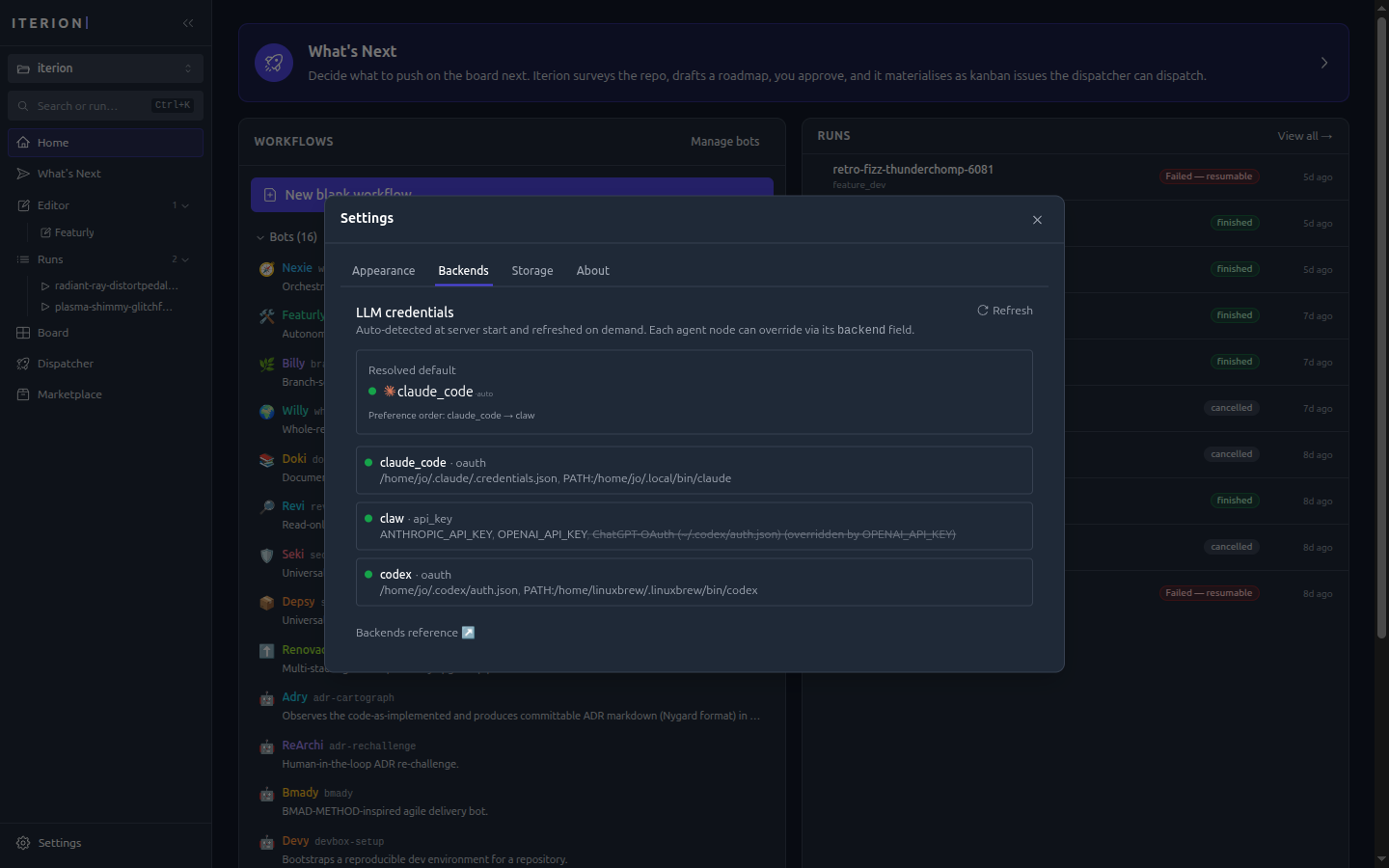
The empty-template path lands on step 4. The pill in the studio toolbar surfaces what the auto-resolver picked (and turns red when no credential is available). Settings → Backends lists every detected source and the resolved default in full:
Launch-time per-node/-group overrides
Above step 1 sits an explicit launch-time override: you can retarget
which model and/or backend specific nodes use for a single run, without
editing the .bot. Because the operator is deliberately re-pointing the
bot at launch, these win over the node’s own DSL backend:/model:.
- Studio — the Launch form’s “Model & backend per node” section lists the bot’s LLM nodes (agents + judges) with a model input (suggesting detected providers’ models) and a backend select; leave a field on inherit to keep the DSL default.
-
CLI — repeatable
--model/--backend, each aselector=value(or a barevaluefor every LLM node). A selector matches by exact node id (reviewer_claude), id glob (reviewer_*,fix_*), or node kind (agent|judge). Most specific match wins; resolution is per-field so--modeland--backendcompose:# cheap model for reviewers, stronger for fixers, all on claw iterion run bots/whole-improve-loop/main.bot \ --model 'reviewer_*=anthropic/claude-fable-5' \ --model 'fix_*=anthropic/claude-sonnet-5' \ --backend '*=claw' - HTTP —
POST /api/runsacceptsmodel_overrides: [{selector, model, backend}].
This composes with the mono/dual --review-mode topology (ADR-052): the
review mode chooses which family runs (one or two), the override chooses
which model/backend each running node uses. Overrides are not yet
re-applied on iterion resume (same limitation as --backend/--compress).
Default preference order
claude_code → claw
codex is intentionally not in the default list. The codex SDK
has known limitations (see codex C030)
and we’d rather have authors opt in explicitly than auto-select it.
You can still set backend: codex per-node, or include it in
ITERION_BACKEND_PREFERENCE to make it eligible for auto-selection.
claude_code is preferred over claw when the user has the Claude
Code OAuth file — that path uses the user’s “forfait” subscription
instead of metered API calls. Without OAuth, claw is preferred:
same auth (ANTHROPIC_API_KEY) but in-process and faster.
⚠️ The Claude Code forfait is usable only through the
claude_codebackend, notclaw.clawcan authenticate with the forfait OAuth token (setANTHROPIC_AUTH_TOKENto theclaudeAiOauth.accessTokenfrom~/.claude/.credentials.json, noANTHROPIC_API_KEY; claw then sendsAuthorization: Bearer+ theanthropic-beta: oauth-2025-04-20header), but it is effectively unusable: the forfait rate-limiter throttles non-Claude-Code clients to ~zero, so aclawrequest429s immediately (rate_limit_error, noRetry-After) even with fresh daily quota — while the officialclaudeCLI on the same token + model works. Anthropic scopes the forfait to Claude Code (Consumer Terms). Whatclaw“lacks” is the Claude Code client identity (User-Agent / client headers); reproducing it would be spoofing, not a fix, so iterion does not. iterion emits a one-time stderr warning if you wire this path anyway. For ananthropic/*model onclaw, useANTHROPIC_API_KEY, z.ai (ZAI_API_KEY), or another provider. (The OpenAI/ChatGPT forfait viaclawdoes work — see below — because there is no equivalent client-identity gate on that path today.)
Overriding the order
Set ITERION_BACKEND_PREFERENCE to a comma-separated list:
# Prefer claw even when Claude Code OAuth is present
export ITERION_BACKEND_PREFERENCE='claw,claude_code'

# Only use codex (must be explicitly listed)
export ITERION_BACKEND_PREFERENCE='codex'
Backends omitted from the list are never auto-selected, even if their credentials exist.
Per-node provider routing & fallback chain (provider:)
The backend: field chooses which execution stack runs a node; the
optional provider: field is a finer credential-routing hint within
that stack. It is resolved per node after ${VAR} / ${VAR:-default}
expansion.
Known hints:
| Hint | Effect |
|---|---|
anthropic |
Force Anthropic-direct (ANTHROPIC_API_KEY / Claude Code OAuth); skip z.ai even when ZAI_API_KEY is set. |
zai |
Force the z.ai Anthropic-compatible facade (ANTHROPIC_BASE_URL=z.ai + ANTHROPIC_AUTH_TOKEN=$ZAI_API_KEY). |
openai |
Force OpenAI-direct (OPENAI_API_KEY), skipping OPENAI_BASE_URL overrides. |
auto / (unset) |
Default process-env precedence. |
Fallback chain
provider: accepts a single value or an ordered, comma-separated
chain. The chain is the declarative generalisation of the
RESCUE_PROVIDER escape hatch:
agent reviewer:
  backend: "claude_code"
  provider: "${RESCUE_PROVIDER:-zai},anthropic"   # z.ai first, Anthropic on hard failure
  model: "claude-opus-4-8"
Semantics:
- Each provider gets the node’s full retry budget (transient errors
are retried in place — see
RetryPolicy). - Only a hard failure beyond the retry budget — a non-retryable
error, or a retryable one whose retries are exhausted — falls through
to the next provider. The executor re-issues the same call with the
next hint and emits one log note (and an
OnProviderFallbackobservability event), so the operator sees a route change, not a failure. - The node only fails if every provider in the chain is exhausted; the surfaced error names the chain that was attempted.
- A cancelled / timed-out run aborts the chain immediately rather than thrashing through every provider.
- Env expansion runs on the whole field first, then the result is
split on commas — so an env var can supply the entire chain
(
${PROVIDERS:-anthropic,zai}) and a:-defaultmay itself contain a comma.
Which backends honour the chain
Only claude_code consumes the provider hint today, and it routes
within the Anthropic-compatible family (anthropic ↔ zai ↔ other
facades) — i.e. the same model id served by a different credential lane.
This is the validated path and the original RESCUE_PROVIDER use case.
claw derives its provider from the model: prefix
(openai/…, anthropic/…), and codex ignores the hint entirely. On
those backends a multi-element chain is a no-op: the runtime uses
only the first provider, and the compiler emits a C088 warning. For
cross-provider failover under claw (e.g. Anthropic → OpenAI), vary the
model: per node instead — a credential hint alone cannot switch the
model that the API expects.
Unknown hint tokens (typos) are flagged at compile time with C087
(a warning) and ignored at run time (the node falls back to default
credential precedence). Fields containing a ${VAR} env ref are left
for run-time resolution and not statically validated.
Single-value provider: (and unset) behaviour is unchanged — the chain
form is purely additive and fully back-compatible.
Per-element model (provider:model)
A provider-specific model can be pinned per chain element with a
provider:model token, so a fall-through swaps both the credential
hint and the wire model:
agent reviewer:
  backend: "claude_code"
  provider: "zai:glm-5.2,anthropic:claude-opus-4-8"   # glm-5.2 on z.ai, claude-opus-4-8 on Anthropic
This is the case where the chain’s two providers serve different model
ids over the same Anthropic-wire API — glm-5.2 is a z.ai model that
Anthropic would reject, so a hint-only swap would break on fall-through.
The token is split on the first colon (a model id that itself
contains a colon survives intact). An element without a model
(anthropic in zai:glm-5.2,anthropic) inherits the node’s model:
baseline; an inheriting element after a model-bearing one restores the
baseline rather than carrying the previous override. A malformed element
— a colon with an empty provider (:glm-5.2) or empty model (zai:) —
warns C172 at compile time. Env expansion still runs on the whole
field first, so the :- in ${VAR:-x} is never mistaken for a
provider:model separator.
Like the hint chain itself, per-element models only take effect on
claude_code (the only backend that walks the chain today).
Transient-error & network resilience
A brief internet/API outage should not abort a whole run. Every backend
call goes through a retry loop (RetryPolicy) with capped exponential
backoff + jitter, and the classifier treats connectivity failures as
retryable:
- Detection (
delegate.IsNetworkError):net.Errortimeouts, wrapped syscall errnos (ECONNRESET,ECONNREFUSED,ETIMEDOUT, …),io.ErrUnexpectedEOF, and a broad message-substring fallback for errors that cross the CLI/SDK boundary as text —fetch failed,socket hang up,getaddrinfo ENOTFOUND,overloaded, 5xx. The run’s owncontext.Canceled/DeadlineExceededare deliberately excluded so a cancelled or timed-out run never thrashes the retry budget. claude_codesilent exits: a connectivity drop surfaces as an opaquesession ended without result message (cli_exit_code=N), with the real cause only on the CLI’s stderr. The delegate re-types it asErrTransientwhen stderr shows a network marker (one explicitnetwork connectivity issue detectedwarn), so the loop retries instead of failing the node.- Adaptive budget: network/transient errors get a larger attempt
budget (
MaxAttemptsTransient, default 6) than ordinary retryable errors (MaxAttempts, default 3), so the backoff spans roughly a minute of outage. An explicitly pinnedMaxAttemptsis always respected (the inflated default only applies when neither is set). Each retry logsnetwork connectivity issue — delegate retry k/n … (backoff …).
Only after a provider exhausts this budget does the run fall through to the
next entry in the provider: chain (above).
Per-backend detection rules
A backend reports Available: true only when both a binary/runtime
and a credential are present. Just having the CLI in PATH is not
enough — the runtime still needs an API key or an OAuth file to
actually make calls.
claude_code
| Credential | Source |
|---|---|
| OAuth (forfait) | macOS: the Claude Code-credentials item in the Keychain (where Claude Code 2.x stores it by default — no file is written). Linux/WSL: $CLAUDE_CONFIG_DIR/.credentials.json (default ~/.claude/.credentials.json; non-hidden credentials.json also accepted) |
| Binary | claude in $PATH, or ~/.claude/local/claude |
On macOS the Keychain is probed for existence only (via
/usr/bin/security find-generic-password — the token is never read), so a
machine logged into Claude Code is detected even though it has no
.credentials.json file. For auto-resolution, OAuth is required. If you
only have ANTHROPIC_API_KEY and the binary, claw is preferred (same auth,
no subprocess fork). To use claude_code with API-key auth, set
backend: claude_code explicitly on the node.
codex
| Credential | Source |
|---|---|
| OAuth | $CODEX_HOME/auth.json (default ~/.codex/auth.json) |
| Binary | codex in $PATH, ~/.volta/bin/codex, ~/.local/bin/codex, /usr/local/bin/codex, /usr/bin/codex |
Same logic as claude_code: only OAuth flips it to “available” for
auto-resolution. OPENAI_API_KEY alone routes to claw.
claw
claw is in-process and pluralised across providers. It reports
Available: true when any of these is set:
| Provider | Detection |
|---|---|
anthropic |
ANTHROPIC_API_KEY or ANTHROPIC_AUTH_TOKEN |
openai |
OPENAI_API_KEY, or Codex CLI signed in via “Sign in with ChatGPT” (see OpenAI via ChatGPT forfait below) |
foundry (Azure) |
AZURE_OPENAI_API_KEY + AZURE_OPENAI_ENDPOINT |
bedrock |
AWS_REGION or AWS_DEFAULT_REGION (full chain handled by AWS SDK) |
vertex |
GOOGLE_CLOUD_PROJECT |
When model: on the agent is also empty, the runtime substitutes a
sensible default for the first available provider — currently
anthropic/claude-opus-4-8 for Anthropic and
openai/gpt-5.4-mini for OpenAI.
OpenAI via ChatGPT forfait (Codex CLI OAuth)
When Codex CLI is signed in via Sign in with ChatGPT (rather than the
default API-key mode), iterion’s claw provider can reuse that OAuth
token to drive OpenAI calls through the ChatGPT-Codex backend
(chatgpt.com/backend-api/codex/responses) — billed against the user’s
ChatGPT Plus / Pro / Team subscription instead of the metered
api.openai.com endpoint.
Setup:
# 1. Install or update Codex CLI (>= 0.130.0 for gpt-5.5 access).
# 2. Sign in via ChatGPT (NOT API-key):
codex logout                     # if previously logged in via API key
codex login                      # follow prompts → "Sign in with ChatGPT"
# 3. Verify auth.json carries chatgpt mode:
jq '.auth_mode' ~/.codex/auth.json   # → "chatgpt"
Iterion auto-detects this on the next iterion run. The status pill
shows the OpenAI provider as available even without OPENAI_API_KEY
set.
Precedence:
OPENAI_API_KEY wins when both are present. The reasoning: an explicit
env var was a deliberate user action — typically a project-scoped BYOK
key, a CI secret, or a shared workspace credential — and silently
spending someone else’s ChatGPT subscription would be a surprising
default. ChatGPT-OAuth activates when OPENAI_API_KEY is unset.
# Force OAuth even with OPENAI_API_KEY set:
export ITERION_OPENAI_USE_OAUTH=1

# Force API-key only (refuse to use OAuth even if no key is set):
export ITERION_OPENAI_USE_OAUTH=0

# Setting OPENAI_BASE_URL (for OpenRouter/Ollama/vLLM) automatically
# disables OAuth so masquerading codex_cli_rs headers don't reach an
# unintended backend.
The studio status pill renders both detected sources, with the
inactive one struck-through and labelled (overridden by …).
Model-version gating. OpenAI’s backend gates model access on the
HTTP version: header iterion sends with each call. By default iterion
derives this from codex --version; override with
ITERION_CODEX_VERSION=X.Y.Z if you need to claim a different version
without reinstalling the binary. Concretely: gpt-5.5 requires
codex-cli >= 0.130; gpt-5.4 works on older versions.
Refresh. iterion does not implement OAuth refresh — it reads
whatever access_token is currently on disk. Codex CLI maintains the
file as a side effect of normal use; if your token expires mid-run,
just codex --version (or any other Codex command) to trigger a
refresh, then re-run iterion.
ToS posture. Unlike Anthropic Pro/Max (whose Consumer Terms scope
the subscription to Claude Code only — see the warning under
z.ai integration),
ChatGPT subscriptions don’t carve out Codex CLI as the only legitimate
surface. Reproducing Codex CLI’s OAuth flow from a third-party tool is
gray-area but has no explicit prohibition today. We treat this as
pragmatic — if OpenAI changes the terms or tightens enforcement, set
ITERION_OPENAI_USE_OAUTH=0 and fall back to OPENAI_API_KEY.
Editor UX
The studio calls GET /api/backends/detect at mount time. The
status pill in the top-left of the toolbar shows:
- 🟢 Green + auto-resolved backend name when at least one credential is detected.
- 🔴 Red “no creds” when nothing is detected. The Run button is disabled in this state.
- Click the pill for a per-backend breakdown, sources, hints, and a link back to this page.
The detection result is cached server-side for 30 seconds. Click Refresh in the popover to re-probe after fixing your env.
Workflow-level pinning
To pin a backend across an entire workflow (e.g. force claude_code
even when OAuth is missing, expecting CI to inject it later):
default_backend: claude_code

agent reviewer:
  # inherits backend: claude_code
  ...
Per-node overrides take precedence:
agent reviewer:
  backend: claw
  model: anthropic/claude-haiku-4-5-20251001
Using a non-Anthropic provider via the Anthropic wire format (z.ai / GLM)
Some providers ship an Anthropic-compatible HTTP endpoint so existing
Claude Code clients can talk to them with zero code change. The most
common case today is z.ai’s Coding Plan, which serves GLM-4.5 /
GLM-4.6 through https://api.z.ai/api/anthropic (or whatever endpoint
your z.ai dashboard lists — confirm there). Anthropic itself encourages
this kind of integration for partner providers; z.ai’s own docs
describe the Claude Code wiring.
Iterion-desktop sources ~/.iterion/env at startup (commit 84a7fc2)
and claudesdk/process.go forwards the entire host env to the spawned
Claude Code subprocess. There are two equivalent ways to wire it.
Shortcut: ZAI_API_KEY alone
Recommended path — drop a single line in ~/.iterion/env:
# ~/.iterion/env
ZAI_API_KEY=<bearer token from your z.ai dashboard>
When iterion sees ZAI_API_KEY set AND no ANTHROPIC_API_KEY /
ANTHROPIC_AUTH_TOKEN set, it automatically configures
ANTHROPIC_BASE_URL=https://api.z.ai/api/anthropic and
ANTHROPIC_AUTH_TOKEN=$ZAI_API_KEY for both the spawned Claude Code
subprocess (backend: claude_code) and the in-process claw provider
factory (backend: claw). Restart iterion-desktop after editing the
file so the launcher re-sources it.
If ANTHROPIC_API_KEY (or ANTHROPIC_AUTH_TOKEN) is also set, that
takes precedence — the shortcut is intentionally “auto-route only
when no Anthropic auth is configured”. This lets a user keep a
fallback Anthropic key for some workflows without losing the z.ai
default.
Explicit form: ANTHROPIC_BASE_URL + ANTHROPIC_AUTH_TOKEN
For full control, set the two env vars directly:
# ~/.iterion/env
ANTHROPIC_BASE_URL=https://api.z.ai/api/anthropic
ANTHROPIC_AUTH_TOKEN=<bearer token from your z.ai dashboard>
# Leave ANTHROPIC_API_KEY UNSET — if both are present, Claude Code
# prefers the API key and routes back to Anthropic, defeating the
# purpose.
Workflows then run unchanged: backend: claude_code still selects
the same delegate, but the network destination is z.ai and the
underlying model is GLM. Model strings stay Anthropic-shaped
(claude-opus-4-7, …); z.ai’s gateway maps them to its own GLM
families internally.
Important caveats
- This only works when Anthropic’s wire-format aliasing exists at the
provider side. If you’re pointing at OpenRouter, Ollama, or another
OpenAI-shaped endpoint, use
backend: clawwithmodel: openai/…OPENAI_BASE_URLinstead.
- API keys only — no forfait via iterion. Both Anthropic’s Consumer
Terms (Pro/Max plans) and z.ai’s Coding Plan terms restrict
subscription benefits to officially supported tools. Driving either
provider’s subscription/OAuth forfait through iterion (or any other
third-party orchestrator) is a ToS violation. Always use a BYOK API
key path:
ANTHROPIC_API_KEY,ZAI_API_KEY, or the BYOK panel in the cloud UI. The legacy in-cloud OAuth-forfait wiring (pkg/server/oauth_routes.go::OAuthKindClaudeCode) is scheduled for removal — see.plans/zai-glm-byok.md. - Cost: iterion’s token-usage panels currently price against an Anthropic rate card. When you route to z.ai the wire shape is unchanged so token counts are still reported, but the dollar estimates are not accurate until a per-provider rate card lands.
Client identity (User-Agent + custom headers) — claw backend
Every claw provider (anthropic, openai, vertex, foundry) sends an
honest User-Agent: claw-code-go/<version> by default. Before
2026-07 no UA was set at all, so Go’s Go-http-client/2.0 leaked onto
the wire — the worst possible fingerprint against endpoints that gate
service on the calling tool (z.ai’s Coding Plan risk-control flags
“SDK-based access” traffic; repeated violations can suspend the
account). Two exceptions: the ChatGPT-OAuth path keeps its
protocol-required codex_cli_rs/<codex version> identity, and
bedrock requests carry the aws-sdk UA (SigV4-signed).
Override precedence (first non-empty wins), identical on the
in-process claw path and the sandboxed __claw-runner (the three env
vars below are forwarded into the container):
ITERION_LLM_USER_AGENT— iterion surface, injected into every claw provider factory (pkg/backend/model/registry.gowithClientIdentity).CLAW_USER_AGENT— claw’s own env override (works for any claw-code-go embedder).- The per-path default (
claw-code-go/<version>, orcodex_cli_rs/<version>in ChatGPT-OAuth mode).
For arbitrary headers, claw honours ANTHROPIC_CUSTOM_HEADERS with
Claude Code’s exact semantics: newline-separated Name: Value pairs,
applied last on every request so they can override any default
header — including the User-Agent:
# ~/.iterion/env — identify as a specific tool against a gated endpoint
ITERION_LLM_USER_AGENT="my-tool/1.0"
# or arbitrary headers, Claude Code style (overrides UA too):
ANTHROPIC_CUSTOM_HEADERS="User-Agent: my-tool/1.0
X-My-Header: value"
A malformed ANTHROPIC_CUSTOM_HEADERS line (no Name: part) fails the
request with an explicit parse error rather than being silently dropped.
ToS caveat. Presenting as another tool is a decision between you and the endpoint you target (e.g. your z.ai subscription’s supported- tools policy) — iterion/claw default to the honest identity and never spoof on their own. This does not change the Anthropic-forfait posture above: the Claude Code subscription remains scoped to Claude Code by Anthropic’s Consumer Terms, and claw’s OAuth path stays dev-purpose-only regardless of the UA you configure.
Troubleshooting
| Symptom | Likely cause | Fix |
|---|---|---|
| Pill is red | No credential detected | Set ANTHROPIC_API_KEY or sign in to Claude Code, then click Refresh |
| Pill is green but Run errors out with “no provider” | Workflow uses model: openai/... but only ANTHROPIC_API_KEY is set |
Switch model to an Anthropic spec, or add OPENAI_API_KEY |
| Pill says “claude_code” but you wanted “claw” | OAuth is found and ranked first | export ITERION_BACKEND_PREFERENCE='claw,claude_code' |
| Pill says “claw” but you wanted Codex | Codex isn’t in the default order | export ITERION_BACKEND_PREFERENCE='codex,claude_code,claw' and ensure $CODEX_HOME/auth.json exists |
| Editor pill stale after fixing env | Server cache (30s) | Click the pill → Refresh |