🧩
Declarative .bot workflows
Chain agents, judges, routers, human gates, tools, and compute into one readable graph — versioned, diffable, re-runnable without an interpreter.
Learn the DSL
The control plane for AI agents — apps have Linux, the cloud has Kubernetes. Define agent workflows as readable .bot files and operate every run — locally, in CI, or across a multi-tenant cloud.

The cloud onboarding, ready to paste: give the whole block below to a fresh session of your AI coding agent — Claude Code, Codex CLI, pi, Cursor, … — and it installs the CLI and the agent skill, connects to Iterion Cloud, registers the MCP server, and verifies readiness. No forge, no repository, no run — the full walkthrough continues from there. It works with any provider you already hold (Anthropic, OpenAI, xAI, ZAI, Kimi, …), and asks for a credential only when the instance's shared pool doesn't already fund your account. Going fully local instead? The quickstart needs no account at all.
Set up Iterion Cloud (https://iterion.cloud — source: https://github.com/SocialGouv/iterion) so it can deploy AI agents on my repositories. Work in order, and pause to ask me whenever a step needs a human decision.

1. Install the CLI: `curl -fsSL https://socialgouv.github.io/iterion/install.sh | sh`, then run `iterion version`.
2. Install the skill that teaches you the .bot DSL: `npx skills add https://github.com/SocialGouv/iterion --skill iterion-dsl`.
3. Connect the CLI to the cloud: `iterion remote login https://iterion.cloud`. It opens a browser approval page — stop and ask me to approve it there. If I cannot open a browser, ask me for a personal access token and run `iterion remote login https://iterion.cloud --token <my-token>` instead.
4. Register the Iterion MCP server: `claude mcp add iterion -- iterion mcp`. If you are not Claude Code, register the same stdio server in your own MCP configuration instead (command `iterion`, args `["mcp"]`).
5. Cloud runs spend an LLM credential. First ask me whether my account is already funded — the instance runs a shared credential pool and platform credentials that let members test for free while capacity lasts (availability is not guaranteed), and my org may already hold keys. If nothing does, ask me for a key from any provider I use — Anthropic, OpenAI, xAI, ZAI, Moonshot (Kimi), OpenRouter, Bedrock, Vertex, or Azure (wire ids: `anthropic`, `openai`, `xai`, `zai`, `moonshot`, `openrouter`, `bedrock`, `vertex`, `azure`) — and store it with `iterion remote api-keys create --provider <provider> --name default --from-env <MY_KEY_ENV_VAR>`. The secret travels through the environment only, never a command argument or a file.
6. Verify, read-only: `iterion remote status` names the instance and my account, `iterion remote bots list` returns the bot catalog, and your `remote_status` / `remote_bots_list` MCP tools answer.

Do not connect any forge or git host, do not enable a repository, and do not launch a run — that is my next step, not yours. If a step fails, stop there and tell me what to fix. Finish by reporting each step's outcome and how to undo the setup (`iterion remote logout`, `claude mcp remove iterion`).A .bot is a readable graph. Here's a plan → implement → review loop that keeps fixing until a judge approves — declarative, versioned, re-runnable:
schema verdict:
  approved: bool
  notes: string

prompt plan_system:
  Turn the request into a concrete plan: files, steps, constraints.

prompt implement_system:
  Implement the plan, then run the tests.

prompt review_system:
  Approve only if the change is complete and the tests pass.

agent plan:
  model: "anthropic/claude-sonnet-4-6"
  system: plan_system

agent implement:
  backend: "claude_code"
  system: implement_system

judge review:
  model: "anthropic/claude-sonnet-4-6"
  output: verdict
  system: review_system

workflow ship_it:
  entry: plan
  plan -> implement
  implement -> review
  review -> implement when not approved as fix(3)
  review -> done when approved
… which compiles to this graph and runs it — in parallel where it can, with budgets, sandboxing, and checkpoints:
Design it on the canvas or edit the source — both stay in sync in the visual studio:
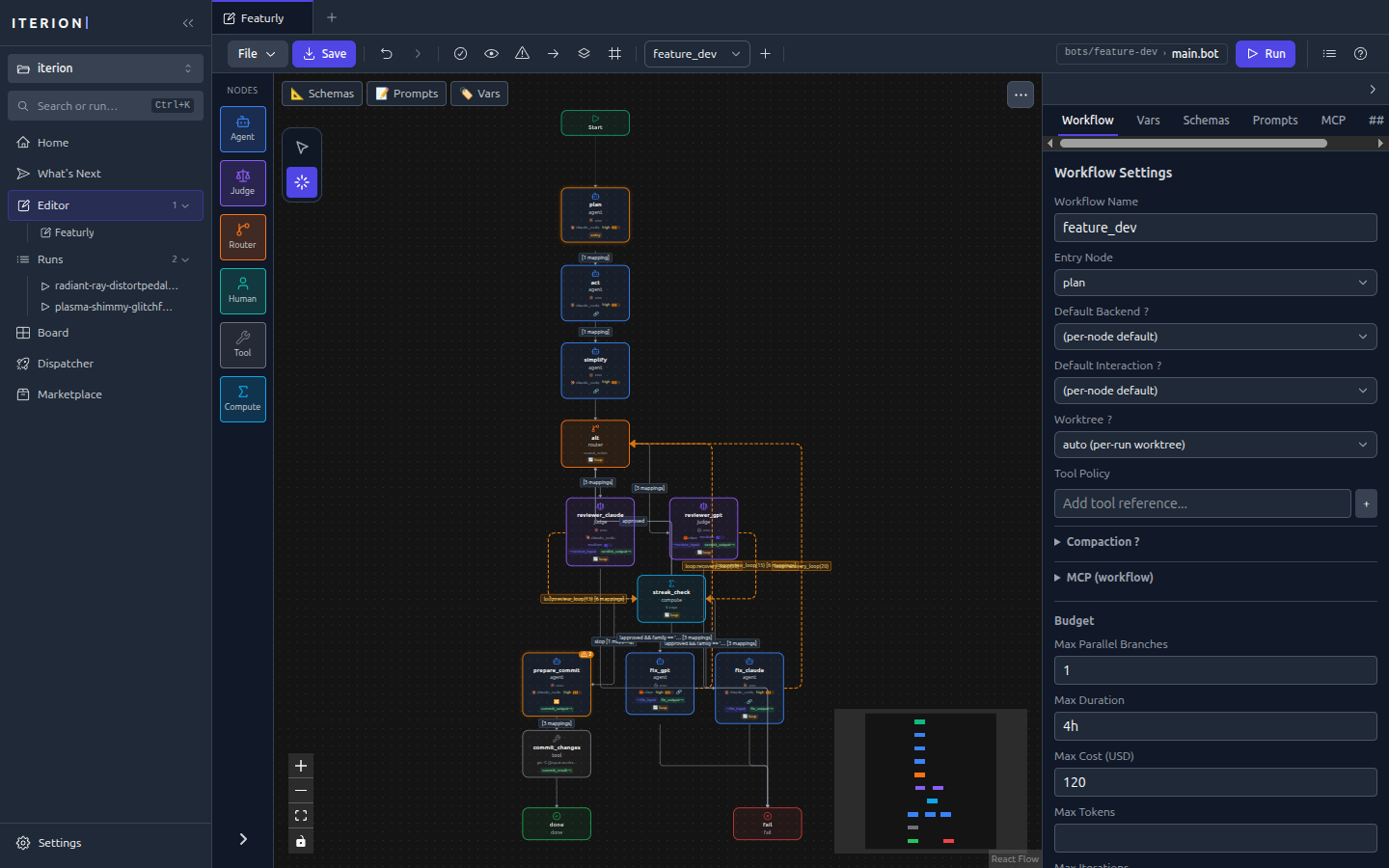
Launch from anywhere; the same compiled graph runs the same way — scheduled in parallel, bounded by budgets, isolated in a sandbox, and checkpointed so it can resume:
Iterion ships a maintained fleet of 30+ production bots — real, grounded examples of what an operated agent workflow looks like. A few of the jobs they do:
| Use case | Bots that run it | |
|---|---|---|
| 🚀 | Ship software from a prompt — greenfield apps and end-to-end features | Appy · Featurly · Fini · Bmady |
| 🔁 | Continuously review & improve a codebase — whole-repo and per-branch campaigns, mono-default PR review with optional cross-family confirmation, test coverage | Willy · Billy · Revi · Testy |
| 🏗️ | Modernise a legacy codebase — behaviour-preserving programmes run lot by lot, over a golden-master net that is proved non-blind by mutation, with a doctrine-bound judge for the blocked cases | Morphy · Goldy · Campy · Themis |
| 🛡️ | Automated security & supply chain — SAST, dependency/SCA, diff-scoped CVE & malware shields on every PR | Seki · Depsy · Vulny · Shieldy |
| ⬆️ | Upgrade dependencies safely — multi-stack agentic upgrades with a review gate | Renovacy · Vetty |
| 📚 | Keep docs & knowledge aligned — docs alignment, wiki generation, ADR cartography and ADR re-challenge | Doki · Wikky · Adry · ReArchi |
| ♿ | Accessibility audits — RGAA / WCAG on the pinned ultra11y engine; the engine finds and gates, agents only adjudicate | Acci |
| 🧪 | Close the end-to-end coverage gap — inventory an app's features from the outside, keep a committed feature×coverage matrix, write the missing specs | Endy |
| 📈 | Make a codebase observable — error tracking, standardized structured logs, opt-in tracing | Obsy |
| 🌐 | Stand up a live review environment — deploy the current commit and hand back a real https URL for e2e tests and human review | Envy |
| 🗂️ | Triage & route work — classify board cards, auto-open PRs, answer PR questions | Triagy · Revi |
| 📡 | Watch & react — feed/veille monitoring and digests | Vigie |
| 🧭 | A strategic partner — a conversational co-CTO and roadmap, an architectural visionary | Nexie · Evoly |
Run any bot as-is, fork and adapt one to your repo, or author your own from scratch — in the visual studio builder, with iterion bots create, or by hand in the readable .bot DSL. Package it as a .botz bundle and share it through the marketplace. The same workflow runs unchanged from your laptop to CI to the cloud.
Every page is held to the code it describes — starting with the diagrams: the whole system, drawn from the source and kept there by a guard — the Mongo data model, the access-control matrix, and 18 feature flows, one per capability.
New here? Start with Why Iterion? for the vision, jump straight to Install, or explore the bot fleet.