iterion
iterion dispatch — long-running dispatcher
The dispatcher turns iterion from a one-shot iterion run into a
dispatcher: it polls an issue tracker, picks the next eligible
issue, runs a workflow against it, and repeats — with retry, stall
detection, per-state concurrency caps and hooks. It is the layer that
makes “an AI sweeps the backlog” a real, supervisable thing rather
than a cron + a prayer.
If you only want a kanban board with no autonomous loop, you don’t
need the dispatcher — see docs/native-tracker.md
for the standalone tracker.
Quick start (zero config)
The fastest path is no YAML at all:
iterion dispatch
Called without an argument, the dispatcher boots with a built-in
preset: the native kanban tracker, the studio HTTP
surface on http://localhost:4892, polling every 30 s, and an
embedded bot catalogue that exposes the workflows from examples/
as assignees. Out of the box you can:
- Open
http://localhost:4892/boardand create a ticket. - Set the ticket’s assignee to one of the names below, drop it
into a state marked
eligible(default:ready/in_progress), and the dispatcher picks it up at the next poll. - The studio’s
/dispatcherroute shows the run in flight.
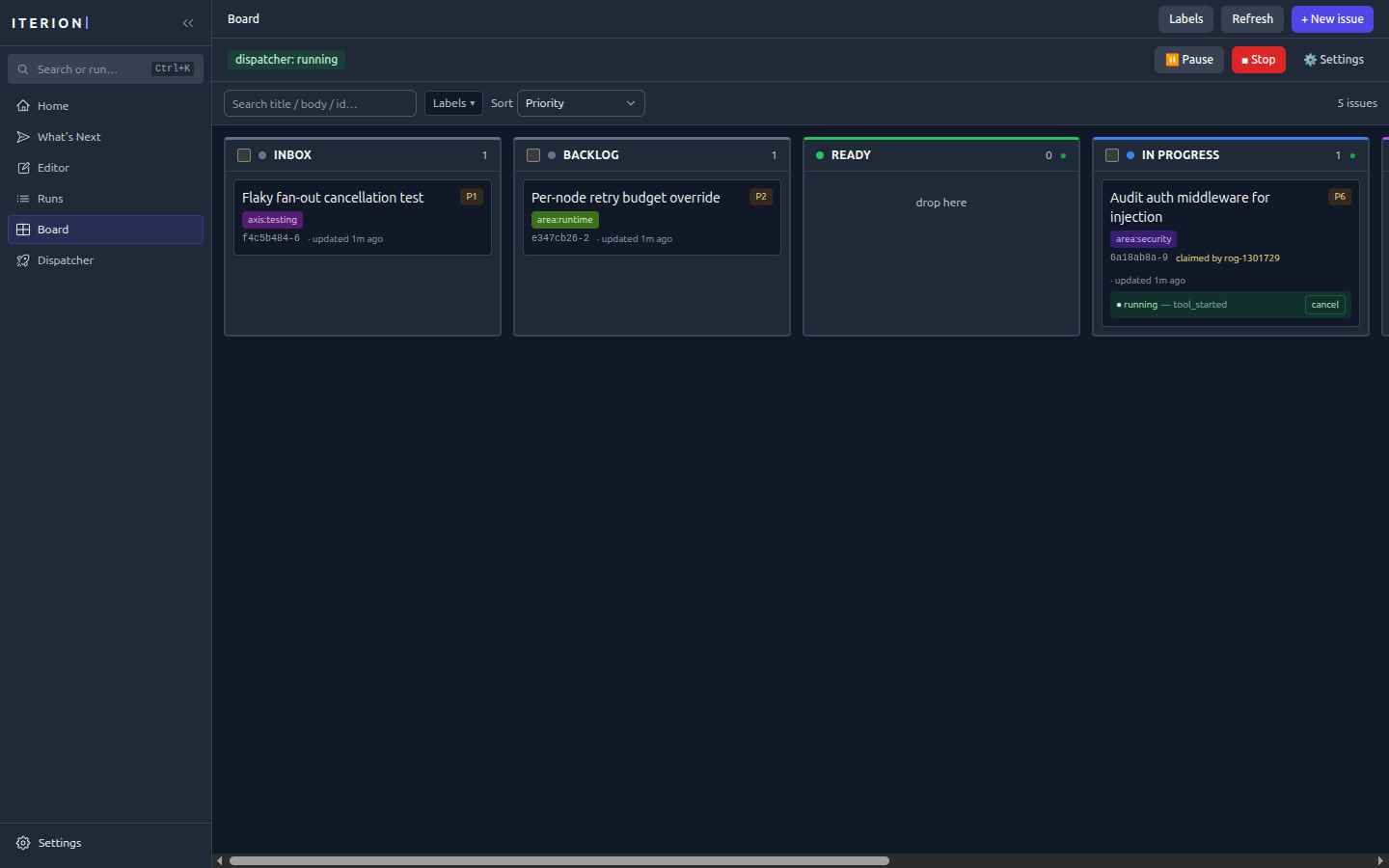
Once claimed, the ticket moves to in_progress and its run attaches to
the card — a live status chip shows it executing right on the board:
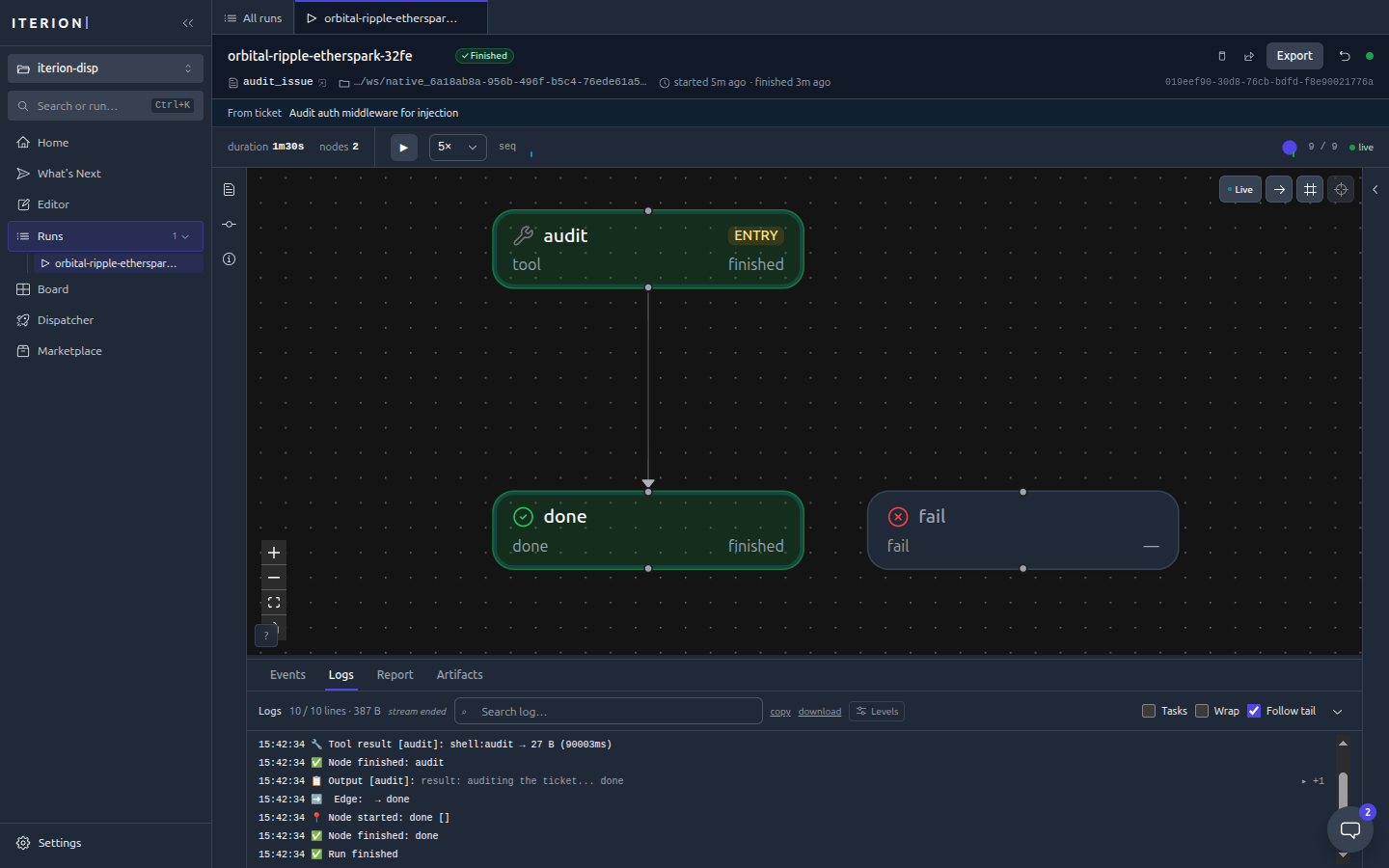
Open that run and the console records the ticket it came from (the From ticket header), closing the loop from issue to execution:
Built-in assignees (source bots):
| Persona | Assignee | Backing bot | What it does |
|---|---|---|---|
| 🛠️ Featurly | feature-dev |
bots/feature-dev/ |
Autonomous feature dev: plan → act → simplify → alternating Claude/GPT review loop |
| 🌍 Willy | whole-improve-loop |
bots/whole-improve-loop/ |
Whole-codebase improvement loop with alternating cross-family verdicts |
| 🌿 Billy | branch-improve-loop |
bots/branch-improve-loop/ |
Branch-scoped improvement + auto-commit on convergence |
| 🧭 Nexie | whats-next |
bots/whats-next/ |
Repo survey → roadmap synthesis → kanban materialisation |
| 📚 Doki | docs-refresh |
bots/docs-refresh/ |
Detect & fix doc/code mismatches |
| 🔎 Revi | review-pr |
bots/review-pr/ |
Read-only cross-family code review; publishes findings to the board |
| 🛡️ Seki | sec-audit-source |
bots/sec-audit-source/ |
Source-code security audit (gitleaks/trivy/semgrep/gosec) |
| 📦 Depsy | sec-audit-deps |
bots/sec-audit-deps/ |
Supply-chain dep audit + LLM review |
| ⬆️ Renovacy | secured-renovacy |
bots/secured-renovacy/ |
Security-aware dependency upgrades with cumulative review |
| — | (unassigned) | default/ (embedded) |
Generic triage agent: classifies the issue and recommends a next step |
Each assignee’s input contract ( + →
the bot’s main prompt var) is wired in
pkg/cli/dispatch_defaults.go.
Bots are extracted on first run under
<store-dir>/dispatcher/bots/<name>/ (write-if-absent so local edits
survive subsequent starts). Override the port via --port, the store
location via --store-dir, or write a full YAML when you outgrow the
defaults.
TL;DR — explicit YAML
# 1. Init the kanban + create a first issue.
iterion issue board init
iterion issue create --title "Investigate flaky test" --state ready --priority 5

# 2. Write an `iterion.dispatcher.yaml` next to your workflow.
cat > iterion.dispatcher.yaml <<'EOF'
name: dev-loop
workflow: ./workflow.bot
tracker:
  kind: native
dispatch:
  vars:
    user_prompt: "Issue : \n\n"
polling:
  interval_ms: 15000
agent:
  max_concurrent: 2
workspace:
  root: ./workspaces
server:
  port: 4892
EOF

# 3. Start the daemon. The dashboard lives at http://localhost:4892.
iterion dispatch iterion.dispatcher.yaml
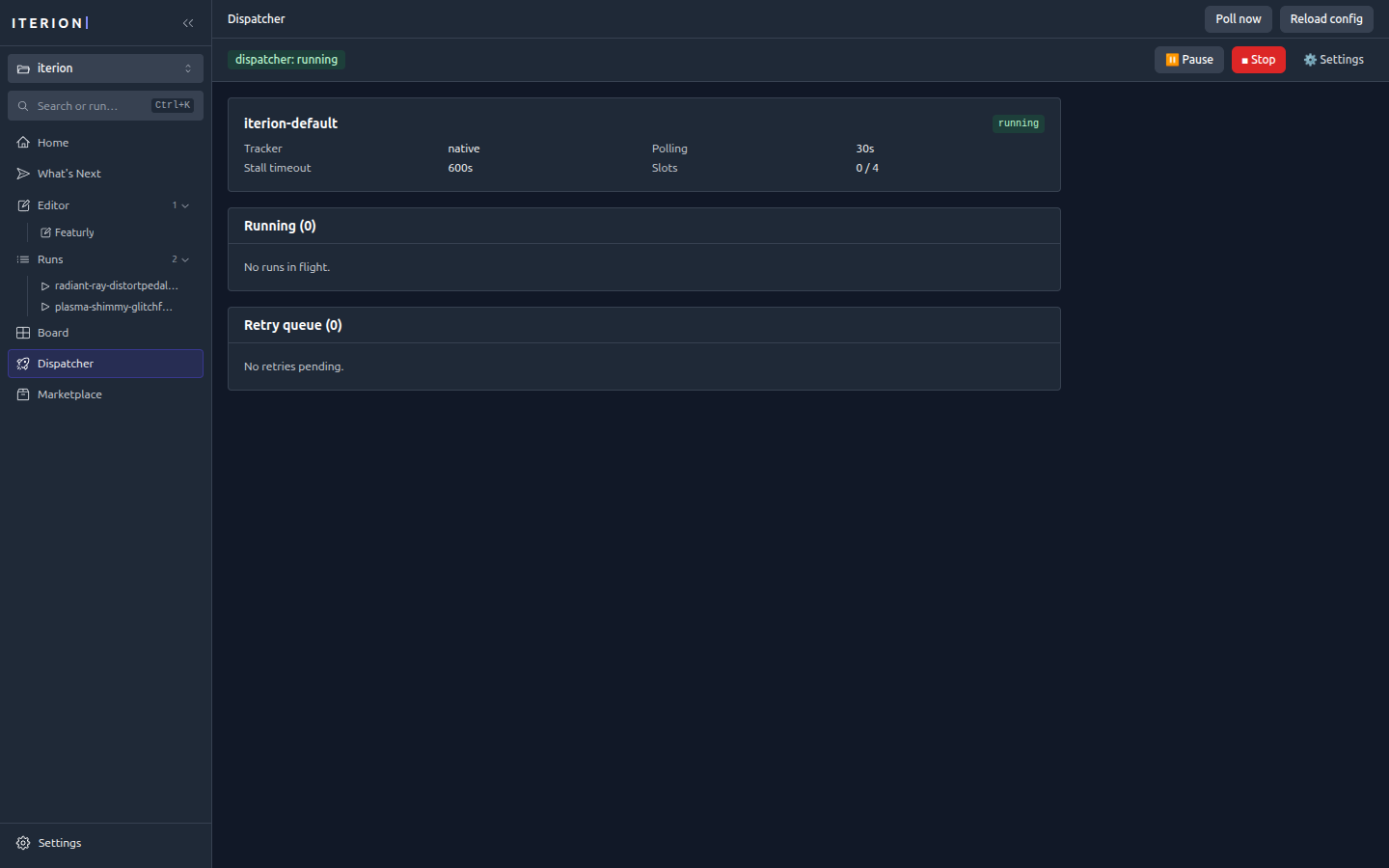
The studio’s /dispatcher route renders the same daemon — its config,
the in-flight runs, and the retry queue, with pause/stop controls:
Mental model
flowchart LR
  TRK["Tracker<br/>(native / GH /<br/>Forgejo)"]
  DSP["Dispatcher<br/>(1 actor goro)"]
  RUN["Runner<br/>(engine = LLM<br/>+ tools)"]

  TRK -- "ListCandidates" --> DSP
  DSP -- "Claim /<br/>Update /<br/>Release" --> TRK
  DSP -- "Dispatch(spec)" --> RUN
A single goroutine — the actor — owns all mutable state. Outside callers (HTTP handlers, retry timers, the config watcher, dispatch goroutines reporting completion) send typed messages on a buffered channel. This mirrors Symphony’s GenServer design with fewer moving parts and zero shared locks across blocking tracker I/O.
State machine
Issues flow through:
stateDiagram-v2
  [*] --> Unclaimed
  Unclaimed --> ClaimedRunning : tick + slot available + tracker.Claim ok
  ClaimedRunning --> Unclaimed : Runner returned nil — tracker.Release,<br/>drop the run, free the slot
  ClaimedRunning --> RetryScheduled : Runner returned error / ctx cancelled<br/>(stall, user cancel, external state change)<br/>Schedule retry with exponential backoff,<br/>claim is freed
  RetryScheduled --> Unclaimed
The slot accounting is global (agent.max_concurrent) plus
per-state (agent.max_concurrent_by_state). A workflow state in
the per-state map cannot exceed its individual cap even when the
global cap has room.
In-progress transition (agent.running_state)
After tracker.Claim succeeds, the dispatcher transitions the issue
to agent.running_state (default in_progress) so the kanban shows
which tickets are being worked on right now. Behaviour:
| Event | Action |
|---|---|
| Claim succeeds, source ≠ target | UpdateState(id, running_state), record source |
| Claim succeeds, source == target | No-op (idempotent) |
| Claim succeeds, transition rejected | Log warn, continue (the claim is already taken) |
running_state: none (or YAML empty) |
Transition disabled — issues stay in their source |
| Workspace create / runID mint fails | Revert state, release claim |
Run cancelled (context.Canceled) |
Revert state, release claim, keep workspace |
| Run failed (non-cancel) | Revert state, release claim, schedule retry |
Run finished cleanly (err == nil) |
No revert. The workflow has either moved the |
state itself (e.g. docs-refresh → review) or the |
|
operator wants to inspect it in running_state. |
|
| Daemon shutdown (Ctrl+C, SIGTERM) | Revert each in-flight ticket’s transition |
Every revert is best-effort and protected by a RefreshStates
safety check: the dispatcher only flips the state back when the issue
is still in running_state. If the workflow already moved it forward
(e.g. docs-refresh → review) or the operator dragged the card on the
kanban mid-run, the revert is skipped so the operator’s action isn’t
clobbered.
To disable the transition (e.g. boards without an in_progress
column), set agent.running_state: none:
agent:
  max_concurrent: 2
  running_state: none   # keep claimed issues in their source state
External trackers (GitHub, Forgejo) map the abstract state to labels;
if the YAML’s state_mapping doesn’t declare in_progress,
UpdateState returns ErrTransitionRejected and the dispatcher
logs + continues without aborting the dispatch.
Polling tick
Each tick (polling.interval_ms, default 30s):
- Reconcile stalled. For every in-flight run, if
time.Since(LastEventAt) > stall.timeout_ms, cancel its context. The worker goroutine then returns and the actor schedules a retry. Setstall.timeout_ms: 0to disable. - Refresh tracker states. Ask the tracker for the current state of every running issue. If the state moved out of the eligible set (operator closed the GitHub issue, dragged the native card to “done”), cancel the worker. The dispatch is yielded back to the tracker as the source of truth.
- Fetch candidates.
tracker.ListCandidates(ctx). The native adapter filters byEligibleboard states; the GitHub adapter passes labels throughgh issue list --search. - Sort.
priority desc, created_at asc, identifier asc. - Dispatch. Walk candidates, skip those already claimed locally or queued for retry, and dispatch as long as both global and per-state slots have room.
- Broadcast snapshot. Publish to the WS bridge so the dashboard shows the new state.
Retry queue
| Trigger | Delay |
|---|---|
Runner returned nil |
Released, no retry. |
| Runner returned error | min(10s × 2^(attempt-1), agent.max_retry_backoff_ms) |
| Stall timeout | Same exponential backoff |
| External state change | Same |
Hook failure (before_run) |
Same |
Retries are timer-driven (time.AfterFunc per issue, no min-heap).
The timer callback posts cmdRetryDue{issueID} on the actor channel
and the next tick reconsiders the candidate (which may by then have
moved out of the eligible set — fine, the dispatcher releases without
re-dispatching).
Workspace lifecycle
<workspace.root>/<sanitized-issue-id>/ is created on first dispatch
for that issue, preserved across retries (so the agent’s incremental
state survives a failure), and removed when the issue reaches a
terminal state — pending workspace.persist policy.
workspace.persist |
Behaviour |
|---|---|
keep |
Never delete. |
cleanup_on_done |
Delete when the engine returns success. |
cleanup_on_terminal |
Delete when the tracker state hits a terminal state. (default) |
The sanitize regex is [^a-zA-Z0-9._-] → _, with a leading dot
escaped (so an issue named .gitignore doesn’t produce a hidden dir).
The resolver refuses workspaces whose symlink resolution lands outside
the configured root.
These dispatcher workspaces are distinct from the engine’s per-run
worktree: auto — the latter is the runtime’s git-isolation
mechanism and lives inside the dispatcher workspace. Both layers
keep their independent lifetimes.
Hooks
hooks:
  after_create:                       # runs once, when the workspace dir
    script: |                         # is first created.
      git clone --depth 1 https://github.com/${ORG}/${REPO} .
    timeout_ms: 120000
  before_run:                         # runs before every dispatch.
    path: ./scripts/prepare.sh        # `path:` invokes a script; `script:`
    timeout_ms: 60000                 # inlines a shell snippet. Exactly
                                      # one of the two must be set.
  after_run: null                     # runs after every dispatch (success
                                      # or failure). Best-effort: failures
                                      # are logged, not surfaced.
  before_remove: null                 # runs just before the workspace dir
                                      # is removed (commit + push your work
                                      # here if you want to keep it).
Hooks execute via sh -lc with cwd=<workspace path>. The dispatcher
exports five environment variables before invoking the hook:
| Var | Value |
|---|---|
ITERION_ISSUE_ID |
full ID, e.g. native:<uuid> |
ITERION_ISSUE_IDENTIFIER |
human-readable, e.g. repo#42 |
ITERION_ISSUE_STATE |
current workflow state |
ITERION_RUN_ID |
the engine run ID for this dispatch |
ITERION_WORKSPACE |
absolute workspace path |
A failed after_create or before_run aborts the dispatch and feeds
the retry queue; failed after_run / before_remove are logged at
WARN.
Dispatch templates
The dispatch.vars block maps workflow input vars to per-issue
values using the same `` syntax the .bot DSL
exposes — but with a narrower set of namespaces.
Attachments are not dispatchable. There is no
dispatch.attachmentssupport: workflow attachments are binary files (referenced as ``), and the dispatcher has no way to turn a per-issue template string into an attachment’s bytes. Declaringdispatch.attachments(orassignee_dispatch[].attachments) is a load-time error, not a silent no-op — pass per-issue context throughdispatch.varsor a ticket’sbot_argsinstead. See ADR-013.
| Reference | Resolves to |
|---|---|
| `` | full tracker ID |
| `` | human label |
| `` | issue title |
| `` | issue body |
`` (alias of workflow_state) |
current state |
| `` | priority as integer |
| `` | assignee login |
| `` | comma-joined label list |
| `` | bracketed [a,b] form |
| `` | metadata URL (native: empty, GH/Forgejo: html_url) |
`` / updated_at |
RFC3339 timestamp |
| `` | typed value of a custom field (native only) |
| `` | adapter-specific metadata |
| `` | the name: from your config |
| `` | the dispatch’s run ID |
| `` | absolute workspace path |
| `` | 0 on first try, N for the (N+1)th retry |
The set of references is closed at parse time: typos like `` fail config validation rather than silently rendering an empty string at dispatch.
Routing by issue assignee
By default the dispatcher dispatches a single workflow (workflow:)
for every eligible issue. To dispatch different workflows for
different assignees — without running multiple dispatcher instances —
add an assignee_workflows: map:
name: dev-loop
tracker:
  kind: native

workflow: workflows/triage.bot                  # default fallback

assignee_workflows:
  feature_dev:        bots/feature-dev/main.bot
  whole_improve_loop: bots/whole-improve-loop/main.bot
  secured-renovacy:   bots/secured-renovacy/main.bot
Resolution rules at dispatch time:
- If
issue.Assigneeis non-empty AND present inassignee_workflows, the dispatcher uses the mapped workflow. - Otherwise (empty assignee, or assignee not in the map), it falls
back to
workflow:.
Matching is exact and case-sensitive. There is no glob /
regex / pattern syntax — keep the keys aligned with what the
producer stamps into --assignee. For the native tracker, the
iterion issue create --assignee <name> flag drops name straight
into issue.assignee; GitHub and Forgejo adapters use the first
assignee’s login.
Each assignee_workflows workflow is pre-compiled at startup and
reused across dispatches — the same lifecycle as the default
workflow:. Path resolution is relative to the dispatcher config
file (same convention as workflow:). Missing files fail
iterion dispatch startup with a precise error.
This is what makes whats-next.bot’s kanban output auto-pilot: the
bot stamps each issue with --assignee feature_dev (or any
catalogued bot), and the dispatcher — with the mapping above —
dispatches the matching workflow without any operator
intervention.
Per-ticket bot + args fields
In addition to the assignee-based mapping above, every native tracker issue carries two dedicated typed fields that are copied into the dispatch request:
| Field | Type | Current stock effect |
|---|---|---|
Bot |
string (JSON bot) |
When non-empty, becomes the dispatch routing key: buildSpec sets routeAssignee = iss.Bot (winning over the issue’s own assignee) and carries it on the spec as DispatchSpec.Assignee — not a workflow path. RoutingRunner selects the precompiled per-bot EngineRunner (its ByAssignee map is keyed by bot/assignee name) and the matching assignee_dispatch var overrides from that key; the bot FILE itself is resolved + route-checked by the guard at the top of dispatch() (the issue is skipped with a warning if the bot can’t be resolved or has no active route). Use assignee_workflows: for production workflow routing today. |
BotArgs |
map[string]string (JSON bot_args) |
Merged over the rendered dispatch.vars key-by-key at launch time. BotArgs wins on shared keys; keys absent from the workflow’s vars: schema are passed through with a warn log (the engine surfaces its own diagnostic). |
Current stock workflow selection is performed by the runner built at
iterion dispatch startup:
assignee_workflows[issue.assignee]→ a precompiled per-assigneeEngineRunnerselected byRoutingRunner.cfg.workflow→ the precompiled defaultEngineRunner.
buildSpec folds a per-ticket Bot into the routing key
DispatchSpec.Assignee (it wins over the issue’s own assignee); the
RoutingRunner above then selects the matching precompiled
EngineRunner by that key, exactly as it does for an
assignee_workflows assignee. DispatchSpec carries no workflow
path — each EngineRunner runs the IR it was constructed with, so to
route a brand-new workflow per ticket you add it to assignee_workflows:
(or supply a custom runner that keys off DispatchSpec.Assignee).
Vars: assignee_dispatch[issue.assignee].vars (or dispatch.vars
as fallback) are rendered first, then BotArgs is merged on top.
See pkg/dispatcher/loop.go
(buildSpec, lines 276-296) for the merge, and
pkg/dispatcher/routing_runner.go
for the stock assignee workflow selection.
How to set bot / bot_args today: REST API only —
POST /api/v1/native/issues or PATCH /api/v1/native/issues/{id}
with { "bot": "feature_dev", "bot_args": { "feature_prompt": "…" } }.
The iterion issue create/update CLI does not yet expose
dedicated bot-selection or bot-argument flags; --field key=value lands in
the freeform Fields map, not in BotArgs, and is not merged into dispatch
vars. Operators driving routing purely through the CLI should rely on
assignee_workflows: + assignee_dispatch: instead.
Per-assignee dispatch overrides
Different bots expect different input vars: feature_dev wants
feature_prompt, whole_improve_loop wants improvement_prompt,
secured-renovacy wants user_prompt. The global dispatch.vars:
binds a single template for every assignee, which doesn’t fit a
heterogeneous bot catalogue.
assignee_dispatch: solves that — when an issue’s assignee has an
entry here, its vars: replace the global dispatch.vars
wholesale for that dispatch:
workflow: workflows/triage.bot
assignee_workflows:
  feature-dev:        bots/feature-dev/main.bot
  whole-improve-loop: bots/whole-improve-loop/main.bot
  secured-renovacy:   bots/secured-renovacy/main.bot

assignee_dispatch:
  feature-dev:
    vars:
      workspace_dir:  ""
      feature_prompt: "\n\n"
  whole-improve-loop:
    vars:
      workspace_dir:      ""
      improvement_prompt: "\n\n"
  secured-renovacy:
    vars:
      workspace_dir: ""
      user_prompt:   "\n\n"

dispatch:
  # Fallback for issues with no assignee or an unmapped one.
  vars:
    issue_title: ""
    issue_body:  ""
Validation rules:
- Every
assignee_dispatchkey must have a matchingassignee_workflowsentry — otherwise startup fails with a precise typo-catching error. - Templates are parsed at load time; an unknown
/field fails fast.
The zero-config mode (iterion dispatch) uses exactly this mechanism
to wire each embedded bot to the issue title/body — see
pkg/cli/dispatch_defaults.go.
Deterministic ticket router (PR-aware)
Opt-in. When enabled, an unassigned new issue (no Bot, no
Assignee) is routed BEFORE the normal resolution by whether a PR
already links it:
- No linked PR → the issue routes to the implement bot (Featurly,
feature-devby default) and is stampedbot:featurly. Featurly implements it and opens a PR — which the inbound PR-webhook then picks up (Revi review, or Billy on a same-repo ticket PR — see webhooks.md). - A PR already links it → the dispatcher steps aside (records a
dispatch-skip, stamps
bot:billyfor visibility) and does not launch anything. The PR-webhook owns that work: it runs the branch-improvement bot (Billy) on the PR branch. Dispatching Billy from the issue would be wrong — an issue carries no PR branch, so Billy would review an empty diff. This is the ticket↔PR dedup: Billy runs exactly once, on the PR, via the webhook.
ticket_router:
  enabled: true
  implement_bot: feature-dev   # bot for a PR-less issue (default)
GitHub setup note. GitHub’s gh issue edit --add-label errors if the
label doesn’t already exist in the repo, so the visible bot:featurly /
bot:billy labels (and the tracker’s claimed_label) must be
pre-created (gh label create bot:featurly …). The label apply is
best-effort and never blocks the routing decision, but the claim
(same --add-label seam) does — an issue can’t be dispatched until its
claimed_label exists. A GitHub issue also needs a state_mapping state
to be a candidate at all (an unlabeled issue with no mapped state is
skipped). The native tracker auto-manages its labels, so this only
applies to the github/forgejo adapters.
The PR-existence check + the visible bot:* label are best-effort
tracker capabilities (HasLinkedPR / ApplyLabel, type-asserted at
runtime). The GitHub adapter implements both via the gh CLI; a tracker
that can’t answer “does this issue have a linked PR?” (native/forgejo
today) degrades to routing every unassigned issue to the implement bot —
it never blocks an issue and never dedups against a PR-webhook it can’t
observe. An explicit per-ticket Bot/assignee always wins; the router
only touches fully-unassigned issues. Implemented in
pkg/dispatcher/loop.go (routeUnassignedIssue).
Hot-reload
The dispatcher watches iterion.dispatcher.yaml via fsnotify with a
200ms debounce. On a valid edit, the new config is swapped in:
| Field | Effect on edit |
|---|---|
polling.interval_ms |
new tick cadence next loop |
agent.max_concurrent[_by_state] |
applied next dispatch decision |
agent.running_state |
applied next dispatch + revert |
agent.max_retry_backoff_ms |
applied next retry calc |
hooks.* |
applied next dispatch |
dispatch.vars |
applied next dispatch |
stall.timeout_ms |
applied next tick |
workflow:, tracker.kind:, workspace.root |
warn-only; require restart |
tracker.* credentials |
warn-only; require restart |
Invalid reloads (YAML errors, template parse errors, missing workflow file) keep the previous config and log a warning.
Tracker adapters
tracker.kind: native
The kanban store iterion ships with. Storage lives at
<store-dir>/dispatcher/:
board.json                     # state + custom-field schema
issues/<id>.json               # one file per issue
events.jsonl                   # append-only audit log
See docs/native-tracker.md for the full reference.
tracker.kind: github
Shells out to the gh CLI. Auth uses the existing gh auth login by
default; set tracker.github.token: $GITHUB_TOKEN for headless / CI.
tracker:
  kind: github
  github:
    repo: SocialGouv/iterion
    token: $GITHUB_TOKEN                # optional
    include_labels: [dispatcher-eligible]
    exclude_labels: [blocked, on-hold]
    claimed_label: iterion-claimed      # default
    state_mapping:
      ready:       { labels_include: [ready],   labels_exclude: [claimed] }
      in_progress: { labels_include: [claimed] }
The dispatcher’s Claim adds iterion-claimed; Release removes it.
ListCandidates filters via gh issue list --search so pagination
and rate-limit handling come for free.
Environment hygiene. When tracker.github.token is set, iterion
exports it as GH_TOKEN / GITHUB_TOKEN only to the gh subprocess,
and restricts the inherited environment to a curated allowlist
(PATH, HOME, locale, proxy, ssh-agent, gh and git config vars).
This prevents unrelated secrets in iterion’s environment
(ANTHROPIC_API_KEY, OPENAI_API_KEY, FORGEJO_TOKEN, …) from
leaking to gh’s children via /proc/<pid>/environ. GH_TOKEN itself
remains visible to gh’s direct subprocesses (e.g. the git it shells
out to for clone/push) — that is intrinsic to the env-based auth and
only avoidable by writing the token into gh’s on-disk credentials
file via gh auth login --with-token. If your threat model includes
co-located untrusted same-uid processes, prefer pre-authenticating
gh interactively and leaving tracker.github.token empty.
tracker.kind: forgejo
Direct REST client against the Forgejo (Gitea-compatible) API. Auth
is Authorization: token $FORGEJO_TOKEN.
tracker:
  kind: forgejo
  forgejo:
    host: https://codeberg.org
    repo: owner/repo
    token: $FORGEJO_TOKEN
    include_labels: [ready]
    state_mapping:
      ready:       { labels_include: [ready] }
      in_progress: { labels_include: [claimed] }
Same label-driven semantics as GitHub; label updates go through
PUT /api/v1/repos/<owner>/<repo>/issues/<n>/labels so iterion does
not need to resolve numeric label IDs.
HTTP / WS surface
The server.port setting starts the dispatcher’s HTTP server (the
same SPA the studio serves, so you get the kanban + dashboard at
http://localhost:<port>).
| Endpoint | Method | Description |
|---|---|---|
/api/v1/dispatcher/state |
GET | Live snapshot (running, retries, slots). |
/api/v1/dispatcher/refresh |
POST | Force an immediate tick. |
/api/v1/dispatcher/reload |
POST | Re-parse the YAML config. |
/api/v1/dispatcher/issues/{id} |
GET | Per-issue dispatcher view. |
/api/v1/dispatcher/issues/{id}/cancel |
POST | Cancel an in-flight run. |
/api/v1/dispatcher/ws |
WS | Snapshot stream (push on each tick). |
/api/v1/native/* |
— | Kanban store CRUD (when native is wired). |
/api/server/info |
GET | SPA bootstrap (flags dispatcher_enabled, native_tracker_enabled). |
Single-instance safety
The dispatcher refuses to start a second instance against the same
workspace root: it holds an exclusive flock on
<workspace.root>/.dispatcher.lock for its lifetime.
For multiple dispatchers against the same tracker but different
filesystems (e.g. dev laptop + CI), the per-issue claim marker
(iterion-claimed label on GH/Forgejo, claim: field on native)
prevents simultaneous dispatch — each dispatcher writes its own marker
and refuses to dispatch issues marked by anyone else.
Operational tips
- Always pair
iterion dispatchwithiterion studio(or just visithttp://localhost:<server.port>) — the dashboard is much more useful than tailing logs when debugging stall / retry behaviour. - For headless / containerized deployments, set
server.port: 0and scrape/api/v1/dispatcher/statevia Prometheus’json_exporteror similar. - Hot-reload is your friend during workflow iteration: tweak
dispatch.vars, save, watch the next dispatch pick up the new prompt without restarting the daemon. - The dispatcher does not auto-transition issues on success. Your
workflow should call
iterion issue move <id> --to done(or equivalent for external trackers) if you want the issue to leave the eligible set.
Deferred to v2
- Linear adapter.
- SSH workers (run dispatched workflows on remote hosts).
- Persistent retry queue (restart survives in-flight backoff timers).
- Multi-turn continuation (Symphony’s single-thread agent loop).
- Cross-tracker fan-in (one dispatcher watching GitHub + Linear at once).
- Bi-directional sync (mirror GitHub → native, work locally, push back).