iterion
Native kanban tracker
Iterion ships with a first-class issue tracker — no Linear, no GitHub
account required. It is the default backing store for
iterion dispatch, but is fully usable on its own
through the iterion issue CLI or the studio’s Board view.
The native tracker is a deliberate design choice: iterion’s autonomous
loop should not require the operator to lock themselves into a
proprietary issue tracker. External adapters (github, forgejo) are
optional plug-ins, not the source of truth.
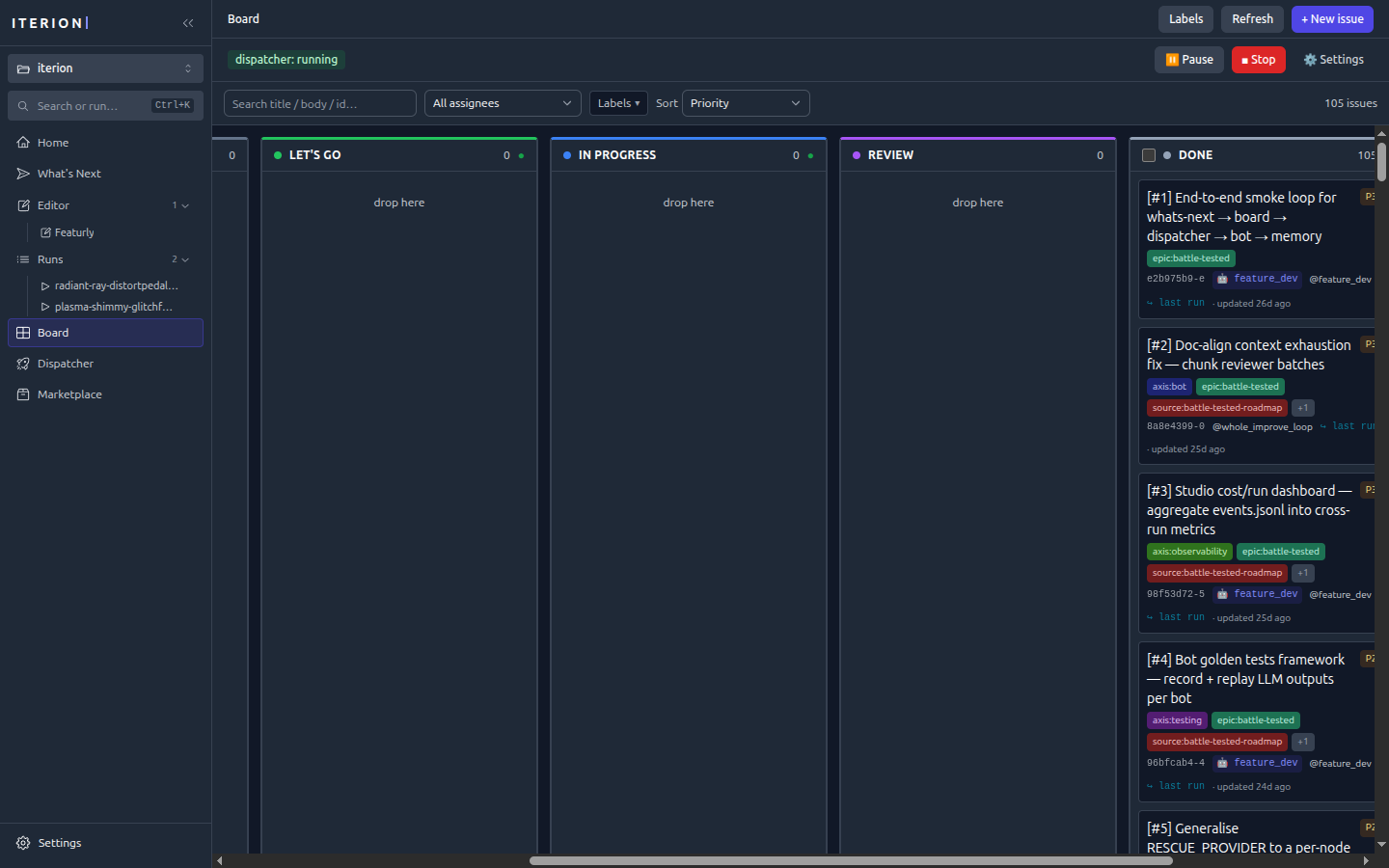
The studio’s Board view (/board) is a drag-and-drop front end over
this store — cards carry labels, priorities, and per-card bot assignees:
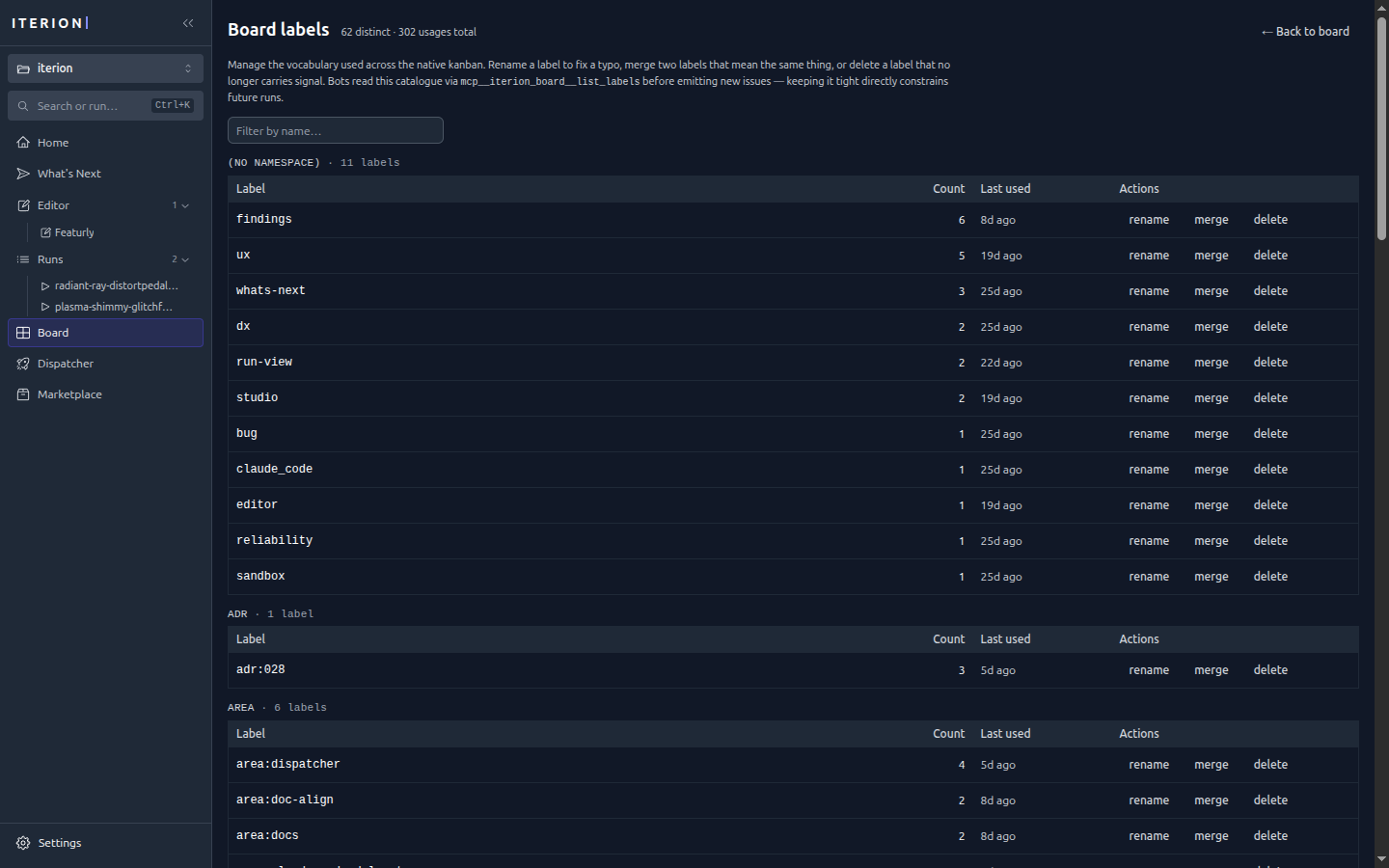
A label manager (/board/labels) keeps the vocabulary tight — bots read
this catalogue before emitting new issues, so renaming or merging a label
directly constrains future runs:
Storage layout
<store-dir>/dispatcher/
  board.json                  # column + custom-field schema
  issues/<encoded-id>.json    # one file per issue
  events.jsonl                # append-only audit log (monotonic Seq)
<store-dir> is the same directory the runtime store uses (resolved
via store.ResolveStoreDir). Issue IDs
are native:<uuid> on the wire; the colon is illegal in NTFS
filenames, so the on-disk encoding swaps it for __.
Writes are serialized through a single mutex. Each mutation appends
one record to events.jsonl. The event types are:
issue_created, issue_updated, issue_state_changed,
issue_deleted, issue_claimed, issue_released,
issue_last_run_updated, board_updated.
The dispatcher stamps every issue it processes with last_run_id
(the run that handled it) + last_workdir (the worktree path on
the host) when the run finishes — success, failure, or cancel.
The studio’s Board view surfaces these as a “Last run” panel on the
issue modal with a link back to /runs/<id> and a
vscode://file/<path> shortcut to open the worktree.
Board
board.json defines what columns exist on the kanban and what custom
fields the operator can attach to issues. Defaults:
{
  "states": [
    { "name": "inbox",       "display": "Inbox" },
    { "name": "backlog",     "display": "Backlog" },
    { "name": "ready",       "display": "Ready",       "eligible": true },
    { "name": "in_progress", "display": "In progress", "eligible": true },
    { "name": "review",      "display": "Review" },
    { "name": "done",        "display": "Done",        "terminal": true },
    { "name": "blocked",     "display": "Blocked",     "terminal": true }
  ],
  "fields": []
}
inbox is the leftmost state. Bots with board.create capability
post their out-of-scope observations there (labeled findings) so
operators can triage on /board without a separate inbox surface —
drag inbox → backlog to promote, delete the card to dismiss.
| Property | Meaning |
|---|---|
eligible: true |
Dispatcher will dispatch issues sitting in this state. |
terminal: true |
Dispatcher treats this state as a stop signal; blocker dependencies |
| resolve. |
A state can be both eligible and terminal — for example a
completed column that triggers a final wrap-up workflow before
issues leave the board.
Custom fields
A board may carry typed custom fields. Schema is enforced on every issue write — unknown fields and bad types are rejected.
{
  "states": [...],
  "fields": [
    { "name": "severity",  "type": "enum",   "enum_values": ["low", "medium", "high"], "required": true },
    { "name": "due_date",  "type": "date" },
    { "name": "story_pts", "type": "number" },
    { "name": "external",  "type": "bool" }
  ]
}
type |
Value shape |
|---|---|
text |
string |
number |
int or float |
bool |
true / false |
date |
RFC3339 string |
enum |
string ∈ enum_values |
Field values are rendered into workflow inputs via
`` in the dispatcher’s dispatch.vars block.
CLI — iterion issue
The full CLI works against <store-dir>/dispatcher/ directly; it does
not need the dispatcher daemon to be running.
iterion issue create   --title T [--body B] [--state S] [--label L]+
                       [--priority N] [--assignee A] [--blocker ID]+
                       [--field key=value]+

iterion issue list     [--state S]+ [--label L]+ [--assignee A]
                       [--claimed] [--unclaimed]

iterion issue show     <id-or-prefix>
iterion issue move     <id-or-prefix>  --to <state>
iterion issue update   <id-or-prefix>  [--title T] [--body B] [--labels L1,L2]
                                       [--priority N] [--assignee A]
                                       [--field k=v]+ [--clear-field K]+
iterion issue close    <id-or-prefix>          # → first terminal state

iterion issue board show
iterion issue board init [--from <board.json>]
<id-or-prefix> accepts the full native:<uuid> form, the bare
UUID, or any uniquely-matching prefix (e.g. the first 8 characters
shown in list).
--field key=value infers the type from the value: true/false →
bool, integers / floats → number, everything else → string. Use
--clear-field key to unset a value.
iterion issue list accepts --json (the global flag) to emit
machine-readable output:
iterion issue list --state ready --json | jq '.[].id'
Open CLI gap: per-ticket bot / bot_args
The underlying native.Issue record carries dedicated typed
fields Bot (string) and BotArgs (map[string]string) — see
the REST surface below — but iterion issue create and
iterion issue update do not yet expose --bot or
--bot-arg flags. --field key=value lands in the freeform
Fields map, NOT in BotArgs.
Until the CLI ships those flags, set the two routing fields via one of:
- the REST API (
POST/PATCH/api/v1/native/issueswith{ "bot": "feature_dev", "bot_args": { "feature_prompt": "…" } }), - a direct
native.Store.Create/Updatecall from Go, - or rely on the dispatcher-side
assignee_workflows:/assignee_dispatch:mappings keyed on--assignee(see docs/dispatcher.md).
REST surface
When iterion runs an HTTP server (iterion studio or iterion
dispatch’s embedded HTTP), the native tracker is exposed under
/api/v1/native/. Auth follows the surrounding server: the studio’s
local mode is unauthenticated; cloud mode gates the routes through the
same JWT middleware as /api/runs/*.
| Endpoint | Method | Body |
|---|---|---|
/api/v1/native/issues |
GET | (query: state, label, assignee) |
/api/v1/native/issues |
POST | {title, body?, state?, labels?, priority?, assignee?, blockers?, fields?, bot?, bot_args?} |
/api/v1/native/issues/{id} |
GET | — |
/api/v1/native/issues/{id} |
PATCH | partial {title?, body?, labels?, priority?, assignee?, blockers?, fields?, bot?, bot_args?} |
/api/v1/native/issues/{id} |
DELETE | — |
/api/v1/native/issues/{id}/transition |
POST | {to: <state>} |
/api/v1/native/board |
GET | — |
/api/v1/native/board |
PUT | full Board |
{id} accepts the same prefix resolution as the CLI.
bot (string) and bot_args (map[string,string]) are
dedicated typed columns on the native Issue record; they are not
part of the freeform fields map. bot_args is merged on top of
the dispatcher’s rendered dispatch.vars key-by-key at launch time,
with bot_args winning on shared keys. bot is resolved into the
dispatch request for custom runners/future routing, but the current
stock EngineRunner is precompiled for one workflow and does not use
the per-ticket bot field to override workflow selection. Use
assignee_workflows: in the dispatcher config for current stock
workflow routing. See docs/dispatcher.md §Per-ticket bot + args
fields for the current handoff.
The SPA’s Board view (/board in the studio) consumes exactly these
endpoints — it’s a thin React shell on top of the REST surface.
Use cases beyond the dispatcher
Even without iterion dispatch running, the native tracker is useful
as a local kanban for:
- Pre-flight backlog grooming. Curate issues before flipping the switch on the dispatcher.
- Per-project task lists. The store lives under the same
<store-dir>as your runs, so issues travel with the project. - Lightweight personal queue. Replace a sticky-note
TODO.mdwith something that survives reflows, accepts custom fields, and speaks JSON.
Programmatic access
The Go package is exported:
import "github.com/SocialGouv/iterion/pkg/dispatcher/native"

s, err := native.NewStore(storeDir + "/dispatcher")
if err != nil { return err }

iss, err := s.Create(native.Issue{Title: "do a thing", State: "ready"})
list, err := s.List(native.ListFilter{States: []string{"ready"}})
_, err = s.SetState(iss.ID, "in_progress")
err = s.Claim(iss.ID, "worker-1")
err = s.Release(iss.ID, "worker-1")
To plug it into the dispatcher’s Tracker interface:
adapter := native.NewAdapter(s) // satisfies tracker.Tracker
Limitations (v1)
- No comments. Events.jsonl is the audit trail; user-facing comments are a v2 ergonomic.
- No bi-directional sync with GitHub / Forgejo. A single dispatcher instance picks one tracker. Mirroring is on the v2 roadmap.
- No persistent retry queue. Restart loses in-flight backoff timers; the next tick re-discovers candidates via the tracker.
- Migration on board.json changes is manual. Renaming a state leaves existing issues in the old name, surfaced as “Unmapped” in the SPA. v2 will support an explicit migration step.
- Field validation is closed-world. Add a new
Fieldto the board before writing any issue that references it.