
🤝 Backends and credential auto-detection
A backend is the executor iterion routes a node to — either the in-process provider client and Iterion-native tool loop, or a coding-agent CLI with its own tool loop — and one workflow can mix them per node. model: is an independent wire-model pin, not a request for a particular backend. Iterion ships six: claw (in-process LLM SDK), claude_code (Claude Code CLI), pi (pi coding agent), kimi (Kimi Code CLI), grok (Grok Build CLI), and codex (Codex CLI). It auto-detects whatever credentials you already have signed in: the default preference considers claude_code and claw; the other four require an explicit opt-in. This page documents the resolution chain, credentials, support boundaries, and overrides.
Cloud BYOK. The auto-detection below is the host/env path. In cloud mode, provider API keys are owned per-org and sealed in Mongo, resolved per-run with a precedence chain (per-webhook override → user default → org default → env fallback). See byok.md.
Backend status
| Backend | Status | Selection |
|---|---|---|
claw | Recommended in-process backend for direct provider calls and native Iterion tools. | Automatic or explicit. |
claude_code | Recommended CLI-agent backend for implementation work and Claude subscription/OAuth use. | Automatic when Claude Code OAuth is detected, or explicit. |
pi | Supported, with iterion's permission gate. Reaches ~36 providers and reports a provider-computed cost. Runs a long-lived --mode rpc session by default — tool events, native steering, authoritative accounting, pre-flight handshake (ITERION_PI_MODE=print rolls back). Permission gate, ask_user, board capabilities and workflow-declared MCP servers (all three transports — streamable http, legacy sse, stdio) work via an embedded extension, which loads on the rpc transport only: a node declaring permission: is refused under ITERION_PI_MODE=print rather than run ungated. | Explicit only. |
kimi | Supported through the generic CLI-agent protocol, with iterion's permission gate in deny only — an external PreToolUse hook can hard-block a call but cannot pause the run for ask, so ask is refused at compile time (C176). A gated node needs sandbox: none (C136 warns), and session resume/fork is not wired. | Explicit only. |
grok | Same generic CLI-agent protocol, and the same deny-only gate, sandbox: none requirement and unwired session resume/fork. | Explicit only. |
codex | Supported Codex CLI backend. Uses Codex's native tool loop and sandbox; see its capability boundaries below. | Per-node/workflow opt-in, or explicit addition to ITERION_BACKEND_PREFERENCE. |
Parity doctrine: claw ↔ claude_code
These two are not alternatives at different tiers — they are meant to be feature-paritary and interchangeable on the same node. claude_code is the more stable, mature harness today; claw is the in-process twin that reaches every provider the registry knows (including providers the CLI cannot speak to). The settled rules:
- A claw gap, error or limitation found in real use is a claw-code-go backlog item, not a disqualification: fix the harness first, then re-judge the model that ran on it.
- Engine capabilities (credentials, fingerprints/meters, permission gate, session resume, events) must land on both backends — or refuse with a typed diagnostic on the one that cannot honour them yet.
- Run-level
fallbackand per-node overrides are the switching mechanism; every production switch doubles as a parity measurement, so switches stay observable (events carry the backend and the served model).
TL;DR
If you have at least one of:
- Claude Code signed in (OAuth in the macOS Keychain on Mac, or
~/.claude/.credentials.jsonon Linux/WSL — "forfait") ANTHROPIC_API_KEYset in your environmentOPENAI_API_KEYset in your environmentXAI_API_KEYset in your environment (xAI Grok)AZURE_OPENAI_API_KEY+AZURE_OPENAI_ENDPOINT- AWS credentials (Bedrock) or
GOOGLE_CLOUD_PROJECT(Vertex)
… then opening the studio, hitting New, and clicking Run will work without any further configuration. The agent in the default template has empty backend: and model: — both are filled in at run time from what's available.
Resolution chain
When a node, workflow, and env are all silent, the runtime resolves a backend in this order (first non-empty wins):
node.Backend— thebackend:line on the agent/judge/routerworkflow.default_backend— the workflow-leveldefault_backend:ITERION_DEFAULT_BACKEND— environment override- Auto — the first backend in
ITERION_BACKEND_PREFERENCEwhose credentials are detected on the host claw— last-resort fallback
The empty-template path lands on step 4. The pill in the studio toolbar surfaces what the auto-resolver picked (and turns red when no credential is available). Settings → Backends lists every detected source and the resolved default in full:
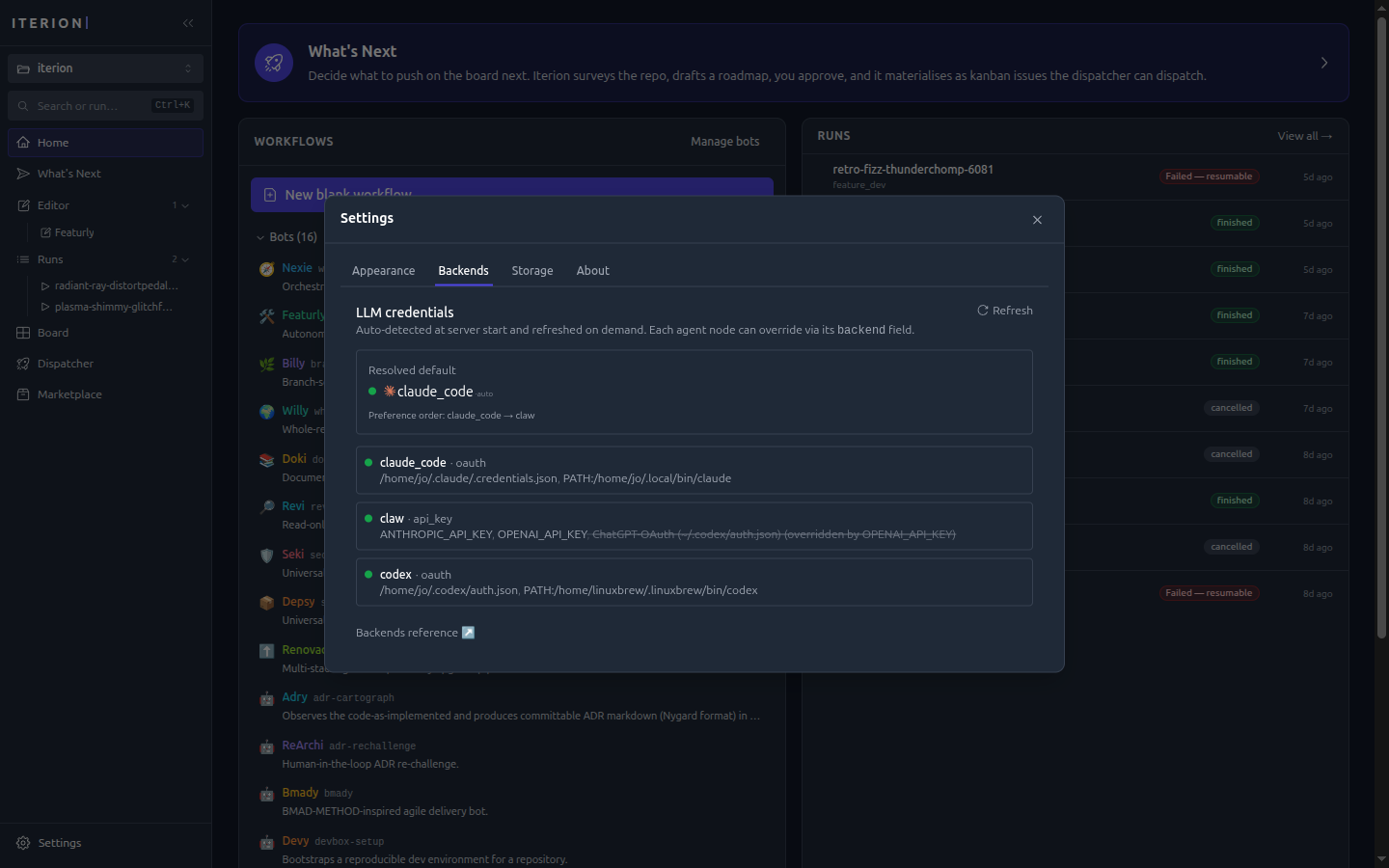
Launch-time per-node/-group overrides
Above step 1 sits an explicit launch-time override: you can retarget which model and/or backend specific nodes use for a single run, without editing the .bot. Because the operator is deliberately re-pointing the bot at launch, these win over the node's own DSL backend:/model:.
Three dimensions are overridable — model, backend and reasoning_effort — because they are one decision: a model, the backend that drives it, and how hard it is asked to think.
Studio — the Launch form's "Model & backend per node" section lists the bot's LLM nodes (agents + judges) with a model picker (fed by the model registry, so each option carries its reachability, context window and price — see docs/models.md) and a backend select; leave a field on inherit to keep the DSL default.
CLI — repeatable
--model/--backend/--effort-for, each aselector=value(or a barevaluefor every LLM node). A selector matches by exact node id (reviewer_claude), id glob (reviewer_*,fix_*), or node kind (agent|judge). Most specific match wins; resolution is per-field so the three compose:bash# cheap model for reviewers, stronger for fixers, all on claw iterion run bots/whole-improve-loop/main.bot \ --model 'reviewer_*=anthropic/claude-fable-5' \ --model 'fix_*=anthropic/claude-sonnet-5' \ --backend '*=claw' \ --effort-for 'fix_*=max'HTTP —
POST /api/runsacceptsmodel_overrides: [{selector, model, backend, effort}]. Aneffortoutsidelow|medium|high|xhigh|max|ultracodeis a 400 at admission, since the value reaches the provider verbatim.
The effort override outranks both the node's static reasoning_effort: and a dynamic _reasoning_effort edge mapping, matching how model and backend already sit at the top of the chain. A bot that escalates effort per branch is therefore flattened by a run-wide * override — which is what asking for one means. See ADR-090.
This composes with the mono/dual --review-mode topology (ADR-052): the review mode chooses which family runs (one or two), the override chooses which model/backend each running node uses. A run launched through the studio / HTTP API re-applies its launch-time model/backend rules on resume (they are read back off the run document) — on every launch surface, iterion run included, so the flags do not have to be repeated on iterion resume. --compress remains launch-only. See docs/models.md.
Default preference order
claude_code → clawcodex is intentionally not in the short default list, just like the other explicit-only CLI backends. This avoids silently changing a workflow's tool surface: Codex uses its native tools and sandbox, whereas claw uses Iterion-native declared tools. Set backend: codex per node/workflow, or include it in ITERION_BACKEND_PREFERENCE to make it eligible for auto-selection.
claude_code is preferred over claw when the user has the Claude Code OAuth file — that path uses the user's "forfait" subscription instead of metered API calls. Without OAuth, claw is preferred: same auth (ANTHROPIC_API_KEY) but in-process and faster.
💳 On
claw(andpi), the Claude Code subscription bills to extra usage, not to your plan.clawauthenticates with the subscription OAuth token (setANTHROPIC_AUTH_TOKENto theclaudeAiOauth.accessTokenfrom~/.claude/.credentials.json, noANTHROPIC_API_KEY; claw then sendsAuthorization: Bearer+ theanthropic-beta: oauth-2025-04-20header), and it works — verified 2026-07-28 with a realclaude-haiku-4-5call. It bills against the subscription's separate extra-usage balance rather than the plan's limits, which is what Anthropic says when that balance empties ("Third-party apps now draw from your extra usage, not your plan limits"). iterion emits a one-time stderr warning naming the billing, andITERION_FORBID_SUBSCRIPTION_OAUTH=1refuses the path outright.This replaces an earlier note that called the path effectively unusable: non-Claude-Code clients used to be throttled to ~zero (immediate
429, noRetry-After) while the official CLI on the same token succeeded. Anthropic has since served third-party clients through extra usage instead. For predictable spend on ananthropic/*model,ANTHROPIC_API_KEYor z.ai (ZAI_API_KEY) remain the metered options. (The OpenAI/ChatGPT forfait viaclawalso works — see below — because there is no equivalent client-identity gate on that path today.)
Overriding the order
Set ITERION_BACKEND_PREFERENCE to a comma-separated list:
# Prefer claw even when Claude Code OAuth is present
export ITERION_BACKEND_PREFERENCE='claw,claude_code'

# Only use codex (must be explicitly listed)
export ITERION_BACKEND_PREFERENCE='codex'
Backends omitted from the list are never auto-selected, even if their credentials exist.
Per-node provider routing & fallback chain (provider:)
The backend: field chooses which execution stack runs a node; the optional provider: field is a finer credential-routing hint within that stack. It is resolved per node after ${VAR} / ${VAR:-default} expansion.
Known hints:
| Hint | Effect |
|---|---|
anthropic | Force Anthropic-direct (ANTHROPIC_API_KEY / Claude Code OAuth); skip z.ai even when ZAI_API_KEY is set. |
zai | Force the z.ai Anthropic-compatible facade (ANTHROPIC_BASE_URL=z.ai + ANTHROPIC_AUTH_TOKEN=$ZAI_API_KEY). |
openai | Force OpenAI-direct (OPENAI_API_KEY), skipping OPENAI_BASE_URL overrides. |
auto / (unset) | Default process-env precedence. |
Fallback chain
provider: accepts a single value or an ordered, comma-separated chain. The chain is the declarative generalisation of the RESCUE_PROVIDER escape hatch:
agent reviewer:
  backend: "claude_code"
  provider: "${RESCUE_PROVIDER:-zai},anthropic"   # z.ai first, Anthropic on hard failure
  model: "claude-opus-4-8"
Semantics:
- Each provider gets the node's full retry budget (transient errors are retried in place — see
RetryPolicy). - Only a hard failure beyond the retry budget — a non-retryable error, or a retryable one whose retries are exhausted — falls through to the next provider. The executor re-issues the same call with the next hint and emits one log note (and an
OnProviderFallbackobservability event), so the operator sees a route change, not a failure. - The node only fails if every provider in the chain is exhausted; the surfaced error names the chain that was attempted.
- A cancelled / timed-out run aborts the chain immediately rather than thrashing through every provider.
- Env expansion runs on the whole field first, then the result is split on commas — so an env var can supply the entire chain (
${PROVIDERS:-anthropic,zai}) and a:-defaultmay itself contain a comma.
Which backends honour the chain
Only claude_code consumes the provider hint today, and it routes within the Anthropic-compatible family (anthropic ↔ zai ↔ other facades) — i.e. the same model id served by a different credential lane. This is the validated path and the original RESCUE_PROVIDER use case.
claw derives its provider from the model: prefix (openai/…, anthropic/…), and codex ignores the hint entirely. On those backends a multi-element chain is a no-op: the runtime uses only the first provider, and the compiler emits a C088 warning. For cross-provider failover under claw (e.g. Anthropic → OpenAI), vary the model: per node instead — a credential hint alone cannot switch the model that the API expects.
Unknown hint tokens (typos) are flagged at compile time with C087 (a warning) and ignored at run time (the node falls back to default credential precedence). Fields containing a ${VAR} env ref are left for run-time resolution and not statically validated.
Single-value provider: (and unset) behaviour is unchanged — the chain form is purely additive and fully back-compatible.
Per-element model (provider:model)
A provider-specific model can be pinned per chain element with a provider:model token, so a fall-through swaps both the credential hint and the wire model:
agent reviewer:
  backend: "claude_code"
  provider: "zai:glm-5.2,anthropic:claude-opus-4-8"   # glm-5.2 on z.ai, claude-opus-4-8 on Anthropic
This is the case where the chain's two providers serve different model ids over the same Anthropic-wire API — glm-5.2 is a z.ai model that Anthropic would reject, so a hint-only swap would break on fall-through. The token is split on the first colon (a model id that itself contains a colon survives intact). An element without a model (anthropic in zai:glm-5.2,anthropic) inherits the node's model: baseline; an inheriting element after a model-bearing one restores the baseline rather than carrying the previous override. A malformed element — a colon with an empty provider (:glm-5.2) or empty model (zai:) — warns C172 at compile time. Env expansion still runs on the whole field first, so the :- in ${VAR:-x} is never mistaken for a provider:model separator.
Like the hint chain itself, per-element models only take effect on claude_code (the only backend that walks the chain today).
Cross-backend fallback routes (fallbacks:)
provider: swaps a credential on one backend. fallbacks: declares complete alternative routes — a different backend, model and credential — for the case the provider: chain cannot serve: a CLI backend whose subscription forfait has shut, continuing on a metered API through claw. See ADR-087.
agent implement:
  backend: "claude_code"          # forfait
  model: "claude-opus-5"
  tools: [read_file, bash]
  fallbacks:
    api:                          # same model, metered Anthropic key
      backend: "claw"
      model: "anthropic/claude-opus-5"
      on: [usage_window]
    gpt:                          # another API family
      backend: "claw"
      model: "openai/gpt-5.5"
      metered: true
Routes are named, and the name is not decoration: it is the id the model_fallback event and the run report cite, so a bilan reads "fell through to api" rather than an ordinal. Declaration order is the try order. Both surfaces compose — the provider: hints are walked first, then each route.
When a route is taken
on: filters which failure may route to an element:
| Category | Meaning | Emitted by |
|---|---|---|
usage_window | subscription 5h/weekly cap — waiting is the only cure for THIS credential | claude_code; pi when the provider echoes Anthropic-shaped prose |
auth | rejected or expired credential | claude_code, pi |
unavailable | model the credential cannot reach | claude_code |
transient_exhausted | a transient condition that survived the in-node retry budget | every backend |
any | escape hatch — clears the filter | — |
The default when on: is omitted is [usage_window, unavailable]. Two omissions are deliberate: any is not the default because a budget cap or a schema-shape failure re-fails identically on every route, and auth is not, because a rejected credential deliberately pauses for a human rather than being automated around. Both remain available explicitly.
on: is a per-route filter, not a chain terminator: a middle route that refuses the category is skipped so a later route that accepts it still runs. The walk ends only when no remaining route accepts.
An unclassifiable failure always routes, whatever the filter says. Refusing it would strand a run on exactly the failures iterion could not describe — a sandboxed claw route flattens its errors to a string at the IPC boundary, and kimi/grok have no error channel at all.
A usage_window failure skips the in-node retry budget when a route remains: retrying inside a shut window cannot succeed, and the whole chain runs under one per-node timeout:.
When a usage_window failure carries a provider reset instant, the executor also puts the effective (backend, credential hint, model) route on a reactive cooldown until that instant. The ledger is ready to do the same for a typed temporary unavailable failure with a reset instant, but no shipped backend produces that stage-3 condition yet. Later nodes in the same run enter the chain at the first route whose on: filter accepts the remembered category, without spawning the refused backend again. The skip remains visible as a model_fallback event with attempts: 0, cooldown: true and cooldown_until; it is an info line rather than another rate-limit warning. The route is remembered even when the node that hit the wall had nowhere to fall through to — a refusal belongs to the route, not to one node's chain — so the next node whose chain does accept the category skips a spawn the first one had to pay for.
Cooldown is strictly fail-open: an absent/already-passed reset, a reset more than eight days out (the same implausibility ceiling as the durable retry's max_wait — a misparsed provider datetime must not keep a healthy route dark for a whole run), or no later route accepting the failure, all leave dispatch unchanged. Entries expire on read at their own reset instant (no sweeper), and the mid-call usage guard stays armed for parallel branches that were already in flight. Operators can set ITERION_ROUTE_COOLDOWN=off before launching a run to restore the historical probe-on-every-node behaviour. The switch is read once when that run's executor is created; unset, on, and unrecognised values keep the cooldown enabled.
Terminal degrade (action: skip) and the route gate (when:)
Two route properties extend the chain beyond backend switches (ADR-091):
vars:
  plan_review_policy: string = "on"   # a route's when: may only read a DECLARED var (C173)

judge plan_review:
  backend: "claw"
  model: "openai/gpt-5.6-sol"
  fallbacks:
    give_up:
      action: skip
      when: "vars.plan_review_policy == 'skip'"
      ## unfiltered on purpose: "skip" here means the peer must NEVER
      ## block — and under `sandbox: auto` a claw failure flattens to a
      ## string at the IPC boundary and classifies UNCLASSIFIED, which a
      ## FILTERED skip refuses (see below). Scope the filter only when
      ## the node runs unsandboxed with typed errors intact.
      on: [any]
action: skip is a terminal degrade: when the walk reaches it, the node COMPLETES with a zero-value output (every schema field at its zero — "" / false / 0 / []) stamped _skipped: true + _fallback_used + _served_by, instead of failing the run. It is the "continue and ignore" half of an optional-node policy — the "pause and retry" half is simply not declaring it: the failure then stays failed_resumable and the run-level usage-window retry parks the run until the window reopens. on: filters it like any route — with one deliberate asymmetry: an unclassified failure (a bare CLI exit, a flattened sandbox error) still routes to any executable route, but a filtered skip REFUSES it — routing an indescribable failure to another backend is a safety net, converting it into a zero-value success is a lie. on: [any] opts in explicitly. The compiler (C173) refuses a skip route that also names a backend/model/provider/metered, an unknown action:, and a skip that is not the LAST route (everything after a terminal is unreachable).
when: gates any route on an expression over vars — evaluated at dispatch, so an ordinary --var picks the active route set per run (that is how ONE plan_review node expresses both wait and skip policies). The compiler checks the expression parses, reads only vars.* (a route has no input/outputs of its own), and references only declared vars — at run time an absent var reads as false and would silently disarm the route. String literals use single quotes (vars.policy == 'skip'); a route whose gate is false is simply absent from the chain.
Downstream, a deterministic compute reads the stamp (outputs.<node>._skipped == true) and routes around whatever consumed the node's real output — never silently. Observability: the model_fallback event carries to_action: "skip" (with an empty to_backend — nothing serves), and the run header's fallbacks chip lists the node with skipped: true even though no backend ran.
What a fall-through leaves behind
Nothing about it is silent:
- a
model_fallbackevent inevents.jsonl(from/to backend, model and provider, the classified reason, attempts spent) plus arun.logwarning for a fresh failure, or an info line for a cooldown skip; - a
model_driftevent when the provider-reported model is not the one the node declared (proxy /ANTHROPIC_MODEL/ a fallback that also changed the model).delegate_startedcarriesdeclared_model;delegate_finished/delegate_erroraddeffective_model;run.jsonnodes_servedis the last pair per node; - a
model_served_via_facadeevent when the session ran through an Anthropic-shaped facade (ANTHROPIC_BASE_URL). The facade answers whateverclaude-*id it is asked for with the model it aliases it to, so the declared and effective ids AGREE andmodel_driftstays silent — the session fingerprint is the only evidence. Raised from the success path only (a delegation that failed was not served); the attempted route still lands onnodes_served[<node>].fingerprint; _backend/_modelon the node output name the route that served, not the one requested;_fallback_usedand_served_byare stamped so a bot's deterministic gate can fail closed on a degraded input — the same posture it already takes on an unreadable one. This matters most for a judge: a weaker model still emits a well-formed verdict, and only the finding count changes;- a failed route's tokens and cost fold into the node's totals, so
max_cost_usdand the org monthly cap see what was really spent; - an exhausted chain surfaces every route's error (
Unwrap() []error), so the run-level usage-window retry and the credential-pool donor cooldown still find the cause they key on.
A fall-through also drops the failed route's conversation — the session store carries no provider fingerprint, so replaying it would send one provider's signed turns to another.
A best-effort session that no longer loads
session: inherit_if_available and session: persist say the session is best effort. Sometimes the id resolves but its backing state is gone — a cloud resume replaces the sandbox container, and the CLI's session files die with it, after which every resume of that node fails identically and forever. "If available" covers that too: the executor retries once with the session dropped.
Deliberately narrow, on three axes:
- Unclassified failures only. That is where a refused session lands (the backend declined to load it and said nothing typed about why), and being non-retryable it makes the fresh attempt a single extra call.
auth/usage_window/unavailableare credential- or model-level — a fresh session hits the same wall — andtransient_exhaustedis a provider-side cause (throttle, 5xx, TCP blip) the session had no part in. - Backends that actually resume with the id —
claw,claude_code,codex,pi. Forclaw,session: persistcheckpoints a compacted, versioned message envelope in the run's backend-session store (32k-token target, eight recent messages preserved, 512 KiB hard blob cap). Asession_slotmay let serial persist nodes share that envelope; absent it, the node id remains the slot. Compaction and envelope loading repair tool protocol half-pairs at message boundaries: orphanedtool_resultblocks and unansweredtool_useblocks are pruned before a provider request. The sole exception is the exact pending tool id recorded by anask_userpause.kimi/grokonly report an id, so there the "fresh" call would be byte-identical. inheritandforknever degrade. They asked for continuity unconditionally, and keep failing loudly.
Like a fall-through, it is not silent: a session_degraded event (backend, session id, reason, error) and _session_degraded: true on the node's own output, so a deterministic gate can fail closed on an amnesiac input. It is not a model_fallback and does not set _fallback_used: the same backend, model and credential served — what degraded is the node's input. The node's accumulated claw conversation is evicted alongside, so "fresh" means fresh on every backend.
Provider fingerprints are checked before replay. A claw session produced by OpenAI is never replayed into Anthropic (or the reverse): the runtime emits session_degraded, discards the opaque conversation, and relies on the bot's bounded host projection instead of forwarding provider-signed thinking blocks. Within one live claw fallback chain, the executor instead rolls back the failed attempt to the route's last-good, provider-neutral message snapshot. This keeps a named durable chat slot intact without carrying partial output into the next route.
Refusals
Two crossings are compile-time errors (C176), because the degraded run would be silently wrong rather than merely worse:
- a route on a backend/mode pair that cannot enforce the node's
permission:gate (kimiandgrokacceptdenybut notask;codexis not admitted at all) — the anti-prompt-injection boundary must not disappear at the moment the run is under stress. The same check now covers the primary backend, not only fallbacks; - a route crossing the claw⇄CLI boundary, because the
tools:list does not mean the same thing on both sides. The two directions are not symmetric:- claw → CLI is refused outright, whatever the list. Under the always-on
bypassPermissionsa CLI agent ignores the lowercasetools:list and carries the full native toolset, so a reviewer restricted toread_filewould gain Edit/Write the moment the chain falls through — on a node the engine may already have admitted as a read-only parallel branch. - CLI → claw is refused only when the list is empty, which on claw means zero tools. Declaring the tools explicitly is the documented pattern: inert on the CLI primary, load-bearing on the claw route.
- claw → CLI is refused outright, whatever the list. Under the always-on
A third refusal is C135: a claw route on a node whose tools: list names something claw cannot resolve. The list is inert on the CLI primary, so a name like run_command or list_files looks harmless there — but the route resolves every name against the in-process registry, so it would fail at the exact moment the run is already falling back. Declare the tools with claw's own names (bash, glob, …); the diagnostic names the nearest one.
A route that changes backend: must pin its own model: (C173): model specs are not portable (claw needs provider/model, claude_code accepts a bare id or an anthropic/ prefix).
At launch, without editing the bot
An operator can add one run-level route instead of authoring a block — the studio Launch form's "Fallback route" row, or:
iterion run bot.bot --fallback 'claw:openai/gpt-5.5'It applies to agent nodes that declare no fallbacks: of their own, and never to judges — a weaker judge still emits a well-formed verdict, so a blanket launch setting must not reach one. An author who wrote a chain vetted where it may go, so their routes win rather than being extended. It takes the default on: set; anything finer belongs in the .bot.
The route is materialised onto the compiled workflow at launch, not resolved privately at dispatch. That is what subjects it to the same refusals as an authored route — an ungated crossing or a claw⇄CLI crossing on a tools-less node is dropped with a warning, never silently taken — and what makes it visible to the three pre-run analyses (sandbox bind-mount, parallel-branch admission, the fan_out_each guard). Without that, a flag could reach exactly the crossings the compiler refuses in the .bot.
The route does not propagate into a subbot: child. A subbot is a different bot with its own routes, its own judges and its own permission posture; the launch route applies to the run you launched, and a child that needs one declares it or is launched with its own. Launch rules are not persisted either, so repeat --fallback on iterion resume to keep the route: the scenario this feature exists for — a long run outliving a quota window — is precisely the one that resumes.
One route rather than a per-node ordered list, deliberately: the value is "don't lose a long run to a forfait wall", which one alternative delivers, and the Launch form persists nothing between launches — a per-node chain would be rebuilt cell by cell on every launch of a 15-node bot.
Routes from all three sources (provider hints, authored routes, the launch route) are deduped: one resolving to the same backend + credential + model as the route before it is dropped rather than paying a second full retry budget to fail identically.
Scope
claude_code → claw is the validated lane. kimi and grok sit on a CLI contract that structurally cannot return an error, so no typed trigger can fire for them; Codex is not included in the v1 fallback lane. A sandboxed claw route works — the trigger comes from the failing route, which claude_code types correctly — but its own failure is always unclassifiable, and it cannot serve a node whose permission policy can produce an Ask decision (mode ask, or any explicit ask: rule — which outranks mode deny).
Sandboxed
clawenforces the permission gate for deny-shaped policies. The policy crosses the IPC as a pre-taskpermission_policyenvelope (permission.PolicyConfig, re-parsed in-container by the same parser), and the__claw-runner's own tool loop applies it before every tool — local builtins and proxied tools alike. The pre-task position is the mixed-fleet guarantee: a runner binary too old to know the envelope fatals on "unexpected envelope before task" instead of running the gated node with an empty policy, so the combination fails CLOSED, never open. What cannot cross is an Ask decision — nothing inside the container can pause the parent run — so an ask-capable policy is refused loudly at dispatch (and C136 warns at compile time). Run such a node unsandboxed, or route it toclaude_code.
Transient-error & network resilience
A brief internet/API outage should not abort a whole run. Every backend call goes through a retry loop (RetryPolicy) with capped exponential backoff + jitter, and the classifier treats connectivity failures as retryable:
- Detection (
delegate.IsNetworkError):net.Errortimeouts, wrapped syscall errnos (ECONNRESET,ECONNREFUSED,ETIMEDOUT, …),io.ErrUnexpectedEOF, and a broad message-substring fallback for errors that cross the CLI/SDK boundary as text —fetch failed,socket hang up,getaddrinfo ENOTFOUND,overloaded, 5xx. The run's owncontext.Canceled/DeadlineExceededare deliberately excluded so a cancelled or timed-out run never thrashes the retry budget. claude_codesilent exits: a connectivity drop surfaces as an opaquesession ended without result message (cli_exit_code=N), with the real cause only on the CLI's stderr. The delegate re-types it asErrTransientwhen stderr shows a network marker (one explicitnetwork connectivity issue detectedwarn), so the loop retries instead of failing the node.- Adaptive budget: network/transient errors get a larger attempt budget (
MaxAttemptsTransient, default 6) than ordinary retryable errors (MaxAttempts, default 3), so the backoff spans roughly a minute of outage. An explicitly pinnedMaxAttemptsis always respected (the inflated default only applies when neither is set). Each retry logsnetwork connectivity issue — delegate retry k/n … (backoff …).
Only after a provider exhausts this budget does the run fall through to the next entry in the provider: chain (above).
Per-backend detection rules
A backend reports Available: true only when both a binary/runtime and a credential are present. Just having the CLI in PATH is not enough — the runtime still needs an API key or an OAuth file to actually make calls.
claude_code
| Credential | Source |
|---|---|
| OAuth (forfait) | macOS: the Claude Code-credentials item in the Keychain (where Claude Code 2.x stores it by default — no file is written). Linux/WSL: $CLAUDE_CONFIG_DIR/.credentials.json (default ~/.claude/.credentials.json; non-hidden credentials.json also accepted) |
| Binary | claude in $PATH, or ~/.claude/local/claude |
On macOS the Keychain is probed for existence only (via /usr/bin/security find-generic-password — the token is never read), so a machine logged into Claude Code is detected even though it has no .credentials.json file. For auto-resolution, OAuth is required. If you only have ANTHROPIC_API_KEY and the binary, claw is preferred (same auth, no subprocess fork). To use claude_code with API-key auth, set backend: claude_code explicitly on the node.
MCP isolation. iterion spawns the CLI with --strict-mcp-config, so the only MCP servers a node gets are the ones iterion resolves and passes via --mcp-config: the .bot's mcp_server:/mcp: blocks, the target repo's .mcp.json (workflow autoload_project, default on), and iterion's own ask_user/board servers. The operator's personal user-scope servers (~/.claude.json) do not boot inside bot nodes — inheriting them meant undeclared tools reaching the agent, an npx/server boot per node visit (a CPU spike per iteration on loop-heavy bots), and personal API keys on the subprocess argv. ITERION_CLAUDE_CODE_STRICT_MCP=0 is the escape hatch that restores host-config inheritance. Settings remain inherited independently (--setting-sources, above).
Ambient servers degrade per-server, on every backend. A server a node never named — inherited from the target repo's .mcp.json or the plugin catalog — that fails to boot costs its OWN tools, never the run: claude_code's CLI skips a server it cannot start, pi bounds each connect with ITERION_PI_MCP_CONNECT_TIMEOUT_MS, and claw's in-process splice skips it with a Warn log plus a mcp_server_degraded run event (server, source, error), so the drop is in the run record, not just the process log. Typical case: a repo-scoped server needing a credential the execution host doesn't have (a token-less Sentry server on a cloud runner pod). A tool the node names EXPLICITLY on a dead server still fails loud at resolution — a declared dependency is never silently dropped.
Orchestration-stall guard. A session blocked on TaskOutput / Monitor with no background work to wait on — no Agent/Task spawned, no run_in_background command — can never return; observed on a facade-served model that waited on a task id it had never created. iterion classifies that silence on a short budget (ITERION_CLAUDE_CODE_ORCH_STALL_TIMEOUT), then recovers in place: the CLI's interrupt aborts the pending call, the model is told which wait could not return, and the session continues — instead of the node restart a killed session costs. A recovery that does not close the turn (ITERION_CLAUDE_CODE_ORCH_RECOVERY_TIMEOUT), or a second stall on the same session, aborts for the executor's retry as before. Each classification is a delegate_stall event (outcome: recovered|aborted) and increments iterion_delegate_idle_deadlock_total{backend,model,outcome} on the runner, so a provider's admission can rest on a number. A blocking call that follows real background work keeps the full hot budget. For a deployment that would rather not expose the surface at all, ITERION_CLAUDE_CODE_DISALLOW_ORCHESTRATION_TOOLS=1 withholds Agent, Task, TaskOutput and Monitor from non-ultracode nodes (opt-in; the default keeps that single-subagent surface — see environment-variables.md).
The multi-agent Workflow tool is a different matter: it is withheld from every node that is not reasoning_effort: ultracode, knob or not. Claude Code arms that tool on the word ultracode anywhere in its prompt, and a node's prompt carries the content it works on — a PR whose title or diff mentions the mode would otherwise switch a reviewer into a background multi-agent orchestration the operator never asked for (measured on 2026-09-05: four revi/review runs died at 3–5× their cost cap that way). The mode grants the tool; the effort is the escape hatch.
codex
The Codex backend delegates to the installed Codex CLI through the pinned Agent SDK and uses the CLI's own authentication and native tool loop.
| Credential | Source |
|---|---|
| OAuth | $CODEX_HOME/auth.json (default ~/.codex/auth.json) |
| Binary | codex in $PATH, ~/.volta/bin/codex, ~/.local/bin/codex, /usr/local/bin/codex, /usr/bin/codex |
Same logic as claude_code: only OAuth flips it to "available" for auto-resolution. OPENAI_API_KEY alone routes to claw.
Native Web search (tools: [web_search])
A Codex node receives OpenAI's hosted native Web search only when it declares the canonical DSL tool:
agent researcher:
  backend: "codex"
  model: "gpt-5.6-terra"
  tools: [web_search]
  readonly: true
Iterion sends the pinned SDK configuration web_search="live" for that node and web_search="disabled" for every Codex node that omits it. This avoids Codex's normal cached-search default silently widening the DSL tool contract. It does not use claw's web_search implementation, an MCP server, or shell network access. Hosted search remains available with Codex's read-only sandbox, so full_access: true is neither needed nor implied.
The backend verifies the Codex CLI version before starting any Codex task, because every run sends an explicit web_search mode (live or disabled). A CLI older than the capability-specific minimum fails with an actionable error naming the missing mode and required version. Operators can set CODEX_CLI_SKIP_VERSION_CHECK=1 to bypass the probe when a compatible wrapper does not expose a conventional version string; doing so assumes responsibility for support of the top-level web_search mode. Search calls are emitted as WebSearch tool lifecycle events; Bash remains separate. The SDK currently provides a count and best-effort action/source payload, but no per-call monetary amount, so Iterion's _cost_usd does not include an invented search fee. See Web search & fetch for the backend comparison and cost boundary.
Sandbox and full_access
A codex node runs under codex's own sandbox. readonly: true always selects read-only (and takes precedence over a conflicting full_access: true). Otherwise, an omitted/empty tools: list keeps Iterion's normal "native tools unrestricted" contract and selects workspace-write; a non-empty list uses read-only only when all declared tools are known readers, and workspace-write when it contains a writer/shell tool (both Iterion snake_case names and Claude-style names are recognised). Unknown/custom names conservatively select workspace-write; use readonly: true for an explicit lock-down.
With Codex's default configuration neither read-only nor workspace-write allows shell network egress — so a codex shell cannot reach an external API (e.g. image generation through a local HTTP call). This restriction is separate from provider-hosted Web search described above. A user-level Codex config can override workspace-write network policy; Iterion does not currently rewrite that file, so operators who require a hard network boundary should use an Iterion Docker/Kubernetes sandbox with a backend that supports it.
To grant network access, the pipeline author sets full_access: true on the node. It lifts the sandbox to danger-full-access (unrestricted network + out-of-workspace writes) — the same posture as codex exec -s danger-full-access. It is off by default and opt-in per node in the workflow:
agent make_cover:
  backend: "codex"
  full_access: true    # codex sandbox -> danger-full-access (needed for imagegen / network)
  user: cover_prompt
Other backends ignore full_access (they do not impose the codex sandbox).
Outer-sandbox limitation: the pinned Codex Agent SDK cannot yet route its subprocess through Iterion's Docker/Kubernetes command builder. Iterion fails such a node explicitly instead of silently launching the CLI on the host. Set
sandbox: noneto rely on Codex's own sandbox, or useclaude_code/clawwhen the outer container boundary is required.
Image inputs (images:)
A codex node can receive input images for image-to-image via the node-level images: list. Each entry is a templated path, resolved per run against the node's input/vars/etc. and forwarded to the codex CLI as -i. Empty results (e.g. an optional reference that doesn't apply this run) are dropped.
agent keyframe:
  backend: "codex"
  full_access: true
  images: ["{{input.prev_frame}}", "{{input.identity_anchor}}"]
  user: keyframe_prompt
Use it to seed a generation from a prior image (e.g. reusing the previous keyframe for visual continuity, or a character-identity anchor). Non-codex backends ignore images: (all CLI delegates instead receive launch-time attachments: by path, and the executor requests read_image; the delegated CLI must provide that tool or use its own file/image reader). Native multimodal forwarding is claw-only.
claw
claw is in-process and pluralised across providers. It reports Available: true when any of these is set:
| Provider | Detection |
|---|---|
anthropic | ANTHROPIC_API_KEY or ANTHROPIC_AUTH_TOKEN |
openai | OPENAI_API_KEY, or Codex CLI signed in via "Sign in with ChatGPT" (see OpenAI via ChatGPT forfait below) |
xai | XAI_API_KEY (xAI Grok — OpenAI-compatible chat completions at api.x.ai) |
foundry (Azure) | AZURE_OPENAI_API_KEY + AZURE_OPENAI_ENDPOINT |
bedrock | AWS_REGION or AWS_DEFAULT_REGION (full chain handled by AWS SDK) |
vertex | GOOGLE_CLOUD_PROJECT |
When model: on the agent is also empty, the runtime substitutes a sensible default for the first available provider (the detector's SuggestedModel for the first available provider, in this priority order) — currently anthropic/claude-opus-5 for Anthropic, anthropic/glm-5.2 for z.ai, openai/gpt-5.4-mini for OpenAI, and xai/grok-3 for xAI.
Stream-silence watchdog
Each in-process Claw provider request is protected against indefinite silence, without imposing a total duration limit on a healthy long response. The cold phase allows 5 minutes for the first stream event; after the first event, every event (including a provider ping) resets the hot 15 minute timer. A watchdog expiry is retried through the bounded transient retry budget; a parent node/run cancellation is not retried.
Tune the tiers with ITERION_CLAW_STREAM_COLD_TIMEOUT and ITERION_CLAW_STREAM_IDLE_TIMEOUT (Go durations such as 2m or 20m). Set either to 0 only when that tier must be deliberately disabled.
The tools: list is load-bearing here (C135)
claw is the one backend a node's tools: list actually constrains: it resolves every declared name against the in-process registry and fails the node on one it does not have. So the names must be claw's own — read_file, write_file, file_edit, glob, grep, bash, web_fetch, skill, web_search, the task_* / worker_* families, … — and not the names that circulate in older examples (list_files, run_command, git_diff, search_codebase, tree, patch): none of those has ever been registered.
iterion validate catches this before launch (C135) rather than letting the run die on unknown tool "list_files" after the workspace is prepared, and it names the nearest built-in. The check applies to claw only — on every CLI backend the lowercase list is advisory, so an unknown name there is dead config, not a failure — and it never touches qualified MCP references (mcp.<server>.<tool>, the mcp__server__tool alias form, wildcards), which are resolved when the server connects.
What it lets through, and why. iterion's own board and watch tools are accepted by their bare name (create_issue, subscribe, …): the registry resolves a dot-free name as a unique suffix over the connected MCP tools, and the runtime registers those families for every run.
That same shorthand is why C135 blocks only what it can positively identify — a legacy phantom name, a near-miss typo, an unexpandable ${VAR} — and merely warns on any other unrecognised name. Half the MCP catalog is invisible at compile time: project .mcp.json entries and enabled plugins' servers are merged after compilation, and a claw node gets them spliced in as mcp.<srv>.*, so tools: [firecrawl_search] runs on a host with that plugin enabled. Blocking it would refuse a working workflow to guard a guess. Wiring MCP explicitly (an mcp_server: declaration or an mcp: block, on the workflow or the node) softens even the identifiable names — a server you wire on purpose can expose any name at all.
One thing it does not let through: tools: is the single node field iterion never expands — model:, backend:, command: and timeout: all go through ${VAR} substitution, this one reaches the registry verbatim. A ${VAR} entry can therefore only fail, and C135 says so.
xAI Grok (model: "xai/…")
xAI is a first-class claw provider. Set XAI_API_KEY (or store a BYOK key under provider xai in cloud mode) and point a node at a Grok model:
agent planner:
  backend: "claw"
  model: "xai/grok-3"
  # optional: model: "xai/grok-3-mini"  # reasoning variant
Optional XAI_BASE_URL overrides the host (default https://api.x.ai). A trailing /v1 is stripped automatically so pasting the public OpenAI-SDK base URL (https://api.x.ai/v1) still works — claw's OpenAI-compatible client always appends /v1/chat/completions.
In cloud mode the same key can be stored as a per-org BYOK record with provider: xai (see byok.md). Sandboxed runs with network: allowlist already include api.x.ai in the iterion-default preset.
For web search & fetch on claw (the web_search/web_fetch tools, the SearXNG → Brave → DuckDuckGo backend ladder, ITERION_WEB_SEARCH, and the Firecrawl MCP tier), see web-search.md.
OpenAI via ChatGPT forfait (Codex CLI OAuth)
When Codex CLI is signed in via Sign in with ChatGPT (rather than the default API-key mode), iterion's claw provider can reuse that OAuth token to drive OpenAI calls through the ChatGPT-Codex backend (chatgpt.com/backend-api/codex/responses) — billed against the user's ChatGPT Plus / Pro / Team subscription instead of the metered api.openai.com endpoint.
Setup:
# 1. Install or update Codex CLI (>= 0.130.0 for gpt-5.5 access).
# 2. Sign in via ChatGPT (NOT API-key):
codex logout                     # if previously logged in via API key
codex login                      # follow prompts → "Sign in with ChatGPT"
# 3. Verify auth.json carries chatgpt mode:
jq '.auth_mode' ~/.codex/auth.json   # → "chatgpt"
Iterion auto-detects this on the next iterion run. The status pill shows the OpenAI provider as available even without OPENAI_API_KEY set.
Precedence:
OPENAI_API_KEY wins when both are present. The reasoning: an explicit env var was a deliberate user action — typically a project-scoped BYOK key, a CI secret, or a shared workspace credential — and silently spending someone else's ChatGPT subscription would be a surprising default. ChatGPT-OAuth activates when OPENAI_API_KEY is unset.
# Force OAuth even with OPENAI_API_KEY set:
export ITERION_OPENAI_USE_OAUTH=1

# Force API-key only (refuse to use OAuth even if no key is set):
export ITERION_OPENAI_USE_OAUTH=0

# Setting OPENAI_BASE_URL (for OpenRouter/Ollama/vLLM) automatically
# disables OAuth so masquerading codex_cli_rs headers don't reach an
# unintended backend.
The studio status pill renders both detected sources, with the inactive one struck-through and labelled (overridden by …).
Model-version gating. OpenAI's backend gates model access on the HTTP version: header iterion sends with each call. By default iterion derives this from codex --version; override with ITERION_CODEX_VERSION=X.Y.Z if you need to claim a different version without reinstalling the binary. Concretely: gpt-5.5 requires codex-cli >= 0.130; gpt-5.4 works on older versions.
Refresh. iterion does not implement OAuth refresh — it reads whatever access_token is currently on disk. Codex CLI maintains the file as a side effect of normal use; if your token expires mid-run, just codex --version (or any other Codex command) to trigger a refresh, then re-run iterion.
ToS posture. ChatGPT subscriptions don't carve out Codex CLI as the only legitimate surface. (Anthropic Pro/Max was long read as doing exactly that for Claude Code; it now serves third-party clients and bills them to extra usage — see the note under z.ai integration.) Reproducing Codex CLI's OAuth flow from a third-party tool is gray-area but has no explicit prohibition today. We treat this as pragmatic — if OpenAI changes the terms or tightens enforcement, set ITERION_OPENAI_USE_OAUTH=0 and fall back to OPENAI_API_KEY.
Third-party agent CLIs (pi, kimi, grok, and the CLI-agent seam)
Some agent CLIs have an argument protocol disjoint from claude-code's Session mode (--print, prompt on stdin, --append-system-prompt, …), so neither backend: claude_code nor the per-node command: override (which only swaps the binary while keeping claude-code's argv) can drive them. iterion ships dedicated backends for these as instances of a generic CLI-agent seam (delegate.CLIAgentBackend + CLIAgentProtocol, see ADR-065): build the target CLI's own argv, run with a wall-clock timeout (inside the run's sandbox when active), parse stdout into a structured result, retry on no-output / network transient. Adding another such CLI is a new protocol value, not new plumbing.
pi (pi coding agent)
pi (earendil-works/pi) is a multi-provider agent harness. It is the backend to reach for when you need a model the other backends cannot run.
prompt task:
  Review the diff for correctness and say what must change.

agent review:
  backend: "pi"
  model: "openai/gpt-5.5"   # or cerebras/…, groq/…, zai/…, github-copilot/…
  system: task              # a prompt declaration, never an inline string
Install: npm install -g @earendil-works/pi-coding-agent (Node ≥ 22.19) or curl -fsSL https://pi.dev/install.sh | sh. Pin a specific host binary with ITERION_PI_BIN. The DSL's per-node command: override is consumed only by claude_code; pi ignores it.
What it brings
- ~36 first-class providers behind one agent loop, with an auto-refreshing model catalogue: anthropic, openai, openai-codex, google, vertex, bedrock, azure, github-copilot, xai, zai, moonshot, deepseek, groq, cerebras, mistral, minimax, openrouter, together, fireworks, and more.
pi --list-modelsis the authoritative list for your install. - A provider-computed cost, not an estimate. pi reports
usage.cost.totalper message against its own pricing catalogue; iterion records it verbatim (cost.AnnotateWithUSD) instead of guessing from the static table. It also reports the real input/output split, where the other CLI-agent backends book every token at the output rate. This makesmax_cost_usdand the spend cap quantitatively correct on a CLI backend for the first time. - Its own credential store (
~/.pi/agent/auth.json) with OAuth flows for Anthropic, OpenAI (ChatGPT/Codex) and GitHub Copilot — an authentication path independent of iterion's.
What it does NOT bring
pi deliberately ships a small tool set: read, bash, edit, write, grep, find, ls, and no MCP client at all — plus no subagent/Task, no todo, no web fetch/search, no notebook, no background bash. The iterion pi extension supplies the MCP half; the rest stands. Consequences for a backend: "pi" node:
- The permission gate DOES work (from v3.7.6), supplied by the iterion pi extension that the backend loads automatically.
permission: ask|denyand itsallow:/ask:/deny:rule lists resolve through the samepermission.Policyasclaude_codeandclaw, so all three reach identical verdicts. RPC transport only — a print-mode node has no channel for it. - board
capabilities:DO work (from v3.7.6, RPC transport only): the extension bridges iterion's board MCP endpoint onto pi and registers each tool it advertises. ask_userDOES work (from v3.7.6, RPC transport only): the agent can put a question to the operator, which pauses the run and resumes with their answer.- Async questions DO work (
interaction: async, ADR-081 — from v3.7.6, RPC transport only):ask_user_asyncposts without stopping andawait_answersis the sync point, with the same semantics as claw and claude_code. Answers are delivered mid-run through pi's nativesteer. - workflow
mcp_server:blocks DO work (from v3.7.6, RPC transport only), on all three transports:http(streamable HTTP),sse(the legacy binding) andstdio(a child process). The extension carries its own MCP client — pi has none — and discovers each server's tools throughtools/list, so schemas and capability gating stay with the server. Two things to know:- A sandboxed stdio server runs inside the container, so its
command:must resolve there. Same caveat asclaude_code. - Connecting is bounded by
ITERION_PI_MCP_CONNECT_TIMEOUT_MS(default 10000). Servers connect in parallel during pi's session start — which iterion's own 30s handshake is waiting on — so one unreachable server costs its own tools, not the run. Failures are logged, not fatal.
- A sandboxed stdio server runs inside the container, so its
__ITERION_SECRET_*__placeholders are not materialised. Use file secrets instead (secrets.md) — they are real mounted files and work unchanged.- node
tools:lists are advisory, as for every CLI-agent backend. The one exception iterion enforces is areadonly:node, which pins pi to--tools read,grep,find,ls. - A rejected credential is recorded as meter evidence, on the anthropic wire only. pi mints
ErrAuthFailedfrom the upstream401/403, and iterion records it as ausagecapauthrefusal so the next resolution routes around the dead credential instead of re-picking it — the same behaviour asclaude_code(usage-caps.md). A refusal on any other provider is recorded NOWHERE: pi routes ~36 providers behind one process, the credential-skip evidence is claude_code-metered end to end, and a mislabelled reading would bench a healthy key. Visible as adebugline naming the provider.
A node that needs the remaining native gaps — subagents, todo, web fetch/search, notebooks, or background shell — should stay on claude_code or claw. pi's value is the models those cannot reach, not replacing them on a workflow that depends on those tools.
Behaviour worth knowing
AGENTS.mdis read alongsideCLAUDE.md, and it is the dominant per-call cost. pi walks up from the working directory and injects both. Two consequences:- If your repo carries an
AGENTS.mdmeant for a different agent, it reaches pi nodes too. - Measure it before you budget. On iterion's own tree (a 103 KB
CLAUDE.md) a one-word prompt costs 26,933 input tokens with context files against 448 without — sixty times the input, on every call, before the node does any work. It stays on by default for parity withclaude_code; setITERION_PI_NO_CONTEXT_FILES=1to turn it off when a node does not need the repo's instructions.
- If your repo carries an
The target repo's
.pi/directory is refused. pi executes project-local extensions as TypeScript inside the agent process — the process holding the run's credentials — so trusting a checked-out repository turns prompt injection into code execution. iterion passes--no-approve. Opt in per node withITERION_PI_TRUST_PROJECT=1, and only for a repository you control.Skills are passed explicitly. iterion mirrors bundle/plugin/library skills into
<workspace>/.claude/skills/, which is not one of pi's own lookup roots, so it hands pi that path via--skill.Sessions live with the run, under the store dir (or the workspace when sandboxed) — never
~/.pi/agent/sessions, so concurrent nodes cannot collide and a pruned run takes its sessions with it.pi retries upstream failures itself — 3 attempts, 2s/4s/8s backoff by default — inside iterion's own retry loop. Two consequences, both observed live:
- Those attempts are invisible to iterion's rate-limit classifier, which only ever sees the outcome of the last one.
- The reported cost is short by the discarded attempts. Only the final attempt's transcript survives in pi's
agent_end, so a node that made four billed upstream calls reports one call's tokens and cost. iterion logs a WARN naming the retry count when this happens — an unexplained slow node with a suspiciously low cost is the symptom.
Print mode has no lever to disable this. Pin
ITERION_PI_AGENT_DIRto an agent dir whosesettings.jsonsetsretry.enabled: false(or a smallretry.baseDelayMs) if it matters for your quota accounting.Model patterns are fuzzy-matched, and a near miss is dangerous. pi resolves an unknown pattern against its catalogue rather than failing. Measured:
zai/glm-5resolves toglm-5v-turbo— a vision model, not GLM 5.x. iterion logs a warning whenever the model pi actually used differs from the one requested; watch for it on first use. (A far miss likezai/glm5is safer: it passes through literally and the provider rejects it with a clean 400, typed as deterministic so no retries are burnt.)session: inheritneeds the edge to carry_session_id. Session resume works — but the id travels on the upstream node's output map, and a barea -> bedge does not forward it, so the node silently runs fresh and the agent "forgets" the previous conversation. iterion now warns; the fix isa -> b with { _session_id: "{{outputs.a._session_id}}" }. This is not pi-specific: it applies to every backend.
💳 Subscription credentials bill to extra usage
A Claude Pro/Max OAuth subscription works on pi, and on claw. Anthropic does not reject a third-party app using it — it answers:
Third-party apps now draw from your extra usage, not your plan limits. Add more at claude.ai/settings/usage and keep going.
So the path is supported, but billed against a separate extra-usage balance rather than your plan's limits. That is the one surprising part, so iterion logs a warning naming it on every node that spends a subscription token outside the vendor's own CLI. When the balance is empty the API returns a 400 invalid_request_error whose text mentions nothing about credentials; iterion translates it into a message naming the cause and the ways out, so it does not read like a broken token.
To refuse it instead, set ITERION_FORBID_SUBSCRIPTION_OAUTH=1. Worth doing on a shared or cloud instance, where spending an operator's extra-usage balance is a cost decision taken on behalf of everyone using it. The refusal applies to pi and claw alike; claude_code and codex are unaffected — they spawn the vendor's own CLI, which draws on the plan normally.
For production Anthropic work, a metered ANTHROPIC_API_KEY or a claude_code node remains the predictable choice.
Your own pi login in ~/.pi/agent/auth.json is your relationship with the vendor — nothing is read or injected. github-copilot is untested on this point and iterion injects nothing for it.
openai-codex is the exception, and it is wired. When iterion holds a Codex ChatGPT credential (host ~/.codex/auth.json, or the per-run copy a cloud runner materialises), a pi node targeting that provider gets it seeded into a throwaway PI_CODING_AGENT_DIR — subject to the same ITERION_FORBID_SUBSCRIPTION_OAUTH refusal as the Anthropic path, with a per-node warning when it is used. Verified end to end on a cloud run (2026-07-31): forfait honoured, bash tool call executed in-sandbox, structured output returned.
The gotcha that costs a run: the provider is chosen by the model prefix.model: "openai/gpt-5.4-mini" selects the metered openai provider and spends OPENAI_API_KEY; the forfait path requires model: "openai-codex/gpt-5.4-mini". The bridge silently does nothing for openai/… nodes because they never ask for it — so an exhausted API key reports You have no credits remaining even on an instance whose ChatGPT forfait is connected and working. (ITERION_OPENAI_USE_OAUTH is the claw equivalent of this switch and has no effect on pi.) pi --list-models shows only providers already authenticated on the host, so it will not list openai-codex before a run seeds it.
Environment variables
| Variable | Effect |
|---|---|
ITERION_PI_BIN | Absolute path to the pi binary (e.g. a bun --compile single-file build on a host with no Node). |
ITERION_PI_MODE | print rolls back to the one-shot transport. The default is the long-lived --mode rpc session (tool events, native steering, authoritative accounting, pre-flight handshake). |
ITERION_PI_AGENT_DIR | Pins PI_CODING_AGENT_DIR. Reproducible pi config, but hides the operator's own auth.json — so the OAuth breadth above goes with it. |
ITERION_PI_OFFLINE | 0 re-enables pi's catalogue refresh inside a sandbox (off by default there: an egress policy would stall startup). |
ITERION_PI_TRUST_PROJECT | 1 trusts the target repo's .pi/ resources. See the warning above. |
kimi (Moonshot kimi-code)
Moonshot's kimi-code takes the prompt as -p <prompt> (kimi --print … errors with unknown option '--print'):
kimi -p <prompt> --output-format {text,stream-json} [-m <alias>]prompt task:
Implement the feature described in the issue and run the tests.
agent implement:
backend: "kimi"
model: "kimi-code/kimi-for-coding" # complete kimi-code alias is preserved
system: task
permission: deny # supported on host runsgrok (xAI Grok Build CLI)
xAI's Grok Build coding agent (grok on PATH, typically installed under ~/.grok/bin/grok) is headless via -p / --single, not claude-code Session mode:
grok -p <prompt> --output-format json \
     --permission-mode bypassPermissions --always-approve \
[-m <model>] [--rules <system>] [--reasoning-effort <level>]prompt task:
Implement the feature described in the issue and run the tests.
agent implement:
backend: "grok"
model: "grok-4.5" # or grok-4.5-build, grok-3, …
# model: "xai/grok-4.5" # also fine — the xai/ prefix is stripped
system: task # delivered as --rules (appended to Grok's native prompt)
reasoning_effort: high # optional; mapped to --reasoning-effortThe node's system: is passed as --rules (append), never as --system-prompt-override, so Grok keeps its native agentic baseline (tools, plan, posture). Credentials come from the CLI itself (Grok Build login / ~/.grok config) — iterion does not inject XAI_API_KEY for this backend. That is distinct from calling the xAI HTTP API via backend: claw + model: "xai/…".
Behavioural notes (generic Kimi/Grok delegates)
- Explicit opt-in.
kimi/grokare never auto-detected; setbackend: "kimi"orbackend: "grok". No host credential silently re-targets a run away fromclaude_code/claw. - Credentials are resolved by the CLI itself from its own env/config (e.g.
$MOONSHOT_API_KEYfor kimi, Grok Build OAuth for grok) — iterion inherits the host environment and does not fight the CLI's native resolution. - Permission gate. These CLIs still run their own built-in toolset and a node's
tools:list remains advisory. Forpermission: deny, iterion points the CLI at a per-invocation shadow home (KIMI_CODE_HOME/GROK_HOME) that links the real credentials but adds an iterionPreToolUsehook; the operator's home is untouched, and that shadow home is created outside the workspace so a repo-scoped write rule cannot reach the gate's own registration. The policy itself rides base64-encoded in the hook argv the CLI freezes at session start, never as a re-read file. Both denial paths are live-proven — a real model's real tool call blocked, with a filesystem sentinel rather than model prose as the oracle (e2e/live_feat_permission_{kimi,grok}_test.go) — and both are admitted by C176 fordeny. Grok keeps its--permission-mode bypassPermissions --always-approveflags: grok's own authorization pipeline runsPreToolUsehooks first, before always-approve short-circuits it. External hooks cannot pause the parent run, soask(including explicitask:rules underdeny) is refused. Guarded sandbox runs are also refused because neither CLI currently carries its home and hook binary into the container — so a gated node needssandbox: none(the shipped default isauto, and C136 warns at compile time rather than letting the run die at the agent node). Windows is refused: the hook command is POSIX-quoted and a spawn failure is an ALLOW. - Effort: kimi has no dial (ignored); grok maps
reasoning_effortto--reasoning-effort(ultracodedegrades tohigh). - Sessions are captured for observability (
sessionId) but resume/fork is not yet wired for CLI-agent backends.
Editor UX
The studio calls GET /api/backends/detect at mount time. The status pill in the top-left of the toolbar shows:
- 🟢 Green + auto-resolved backend name when at least one credential is detected.
- 🔴 Red "no creds" when nothing is detected. The Run button is disabled in this state.
- Click the pill for a per-backend breakdown, sources, hints, and a link back to this page.
The detection result is cached server-side for 30 seconds. Click Refresh in the popover to re-probe after fixing your env.
Workflow-level pinning
To pin a backend across an entire workflow (e.g. force claude_code even when OAuth is missing, expecting CI to inject it later):
workflow review:
  entry: reviewer
  default_backend: "claude_code"   # every node without its own backend: uses it
  reviewer -> done

agent reviewer:
  # inherits backend: claude_code
  model: "anthropic/claude-sonnet-4-6"
Per-node overrides take precedence:
agent reviewer:
  backend: "claw"
  model: "anthropic/claude-haiku-4-5-20251001"
Using a non-Anthropic provider via the Anthropic wire format (z.ai / GLM)
Some providers ship an Anthropic-compatible HTTP endpoint so existing Claude Code clients can talk to them with zero code change. The most common case today is z.ai's Coding Plan, which serves GLM-4.5 / GLM-4.6 through https://api.z.ai/api/anthropic (or whatever endpoint your z.ai dashboard lists — confirm there). Anthropic itself encourages this kind of integration for partner providers; z.ai's own docs describe the Claude Code wiring.
Iterion-desktop sources ~/.iterion/env at startup (commit 84a7fc2) and claudesdk/process.go forwards the entire host env to the spawned Claude Code subprocess. There are two equivalent ways to wire it.
Shortcut: ZAI_API_KEY alone
Recommended path — drop a single line in ~/.iterion/env:
# ~/.iterion/env
ZAI_API_KEY=<bearer token from your z.ai dashboard>
When iterion sees ZAI_API_KEY set AND no ANTHROPIC_API_KEY / ANTHROPIC_AUTH_TOKEN set, it automatically configures ANTHROPIC_BASE_URL=https://api.z.ai/api/anthropic and ANTHROPIC_AUTH_TOKEN=$ZAI_API_KEY for both the spawned Claude Code subprocess (backend: claude_code) and the in-process claw provider factory (backend: claw). Restart iterion-desktop after editing the file so the launcher re-sources it.
If ANTHROPIC_API_KEY (or ANTHROPIC_AUTH_TOKEN) is also set, that takes precedence — the shortcut is intentionally "auto-route only when no Anthropic auth is configured". This lets a user keep a fallback Anthropic key for some workflows without losing the z.ai default.
Explicit form: ANTHROPIC_BASE_URL + ANTHROPIC_AUTH_TOKEN
For full control, set the two env vars directly:
# ~/.iterion/env
ANTHROPIC_BASE_URL=https://api.z.ai/api/anthropic
ANTHROPIC_AUTH_TOKEN=<bearer token from your z.ai dashboard>
# Leave ANTHROPIC_API_KEY UNSET — if both are present, Claude Code
# prefers the API key and routes back to Anthropic, defeating the
# purpose.
Workflows then run unchanged: backend: claude_code still selects the same delegate, but the network destination is z.ai and the underlying model is GLM. Model strings stay Anthropic-shaped (claude-opus-4-7, …); z.ai's gateway maps them to its own GLM families internally.
Important caveats
- This only works when Anthropic's wire-format aliasing exists at the provider side. If you're pointing at OpenRouter, Ollama, or another OpenAI-shaped endpoint, use
backend: clawwithmodel: openai/…OPENAI_BASE_URLinstead.
- API keys only — no forfait via iterion. Both Anthropic's Consumer Terms (Pro/Max plans) and z.ai's Coding Plan terms restrict subscription benefits to officially supported tools. Driving either provider's subscription/OAuth forfait through iterion (or any other third-party orchestrator) is a ToS violation. Always use a BYOK API key path:
ANTHROPIC_API_KEY,ZAI_API_KEY, or the BYOK panel in the cloud UI. The legacy in-cloud OAuth-forfait wiring (pkg/server/oauth_routes.go::OAuthKindClaudeCode) is scheduled for removal — see.plans/zai-glm-byok.md. - Cost: iterion's token-usage panels currently price against an Anthropic rate card. When you route to z.ai the wire shape is unchanged so token counts are still reported, but the dollar estimates are not accurate until a per-provider rate card lands.
Client identity (User-Agent + custom headers) — claw backend
Every claw provider (anthropic, openai, vertex, foundry) sends an honest User-Agent: claw-code-go/<version> by default. Before 2026-07 no UA was set at all, so Go's Go-http-client/2.0 leaked onto the wire — the worst possible fingerprint against endpoints that gate service on the calling tool (z.ai's Coding Plan risk-control flags "SDK-based access" traffic; repeated violations can suspend the account). Two exceptions: the ChatGPT-OAuth path keeps its protocol-required codex_cli_rs/<codex version> identity, and bedrock requests carry the aws-sdk UA (SigV4-signed).
Override precedence (first non-empty wins), identical on the in-process claw path and the sandboxed __claw-runner (the three env vars below are forwarded into the container):
ITERION_LLM_USER_AGENT— iterion surface, injected into every claw provider factory (pkg/backend/model/registry.gowithClientIdentity).CLAW_USER_AGENT— claw's own env override (works for any claw-code-go embedder).- The per-path default (
claw-code-go/<version>, orcodex_cli_rs/<version>in ChatGPT-OAuth mode).
For arbitrary headers, claw honours ANTHROPIC_CUSTOM_HEADERS with Claude Code's exact semantics: newline-separated Name: Value pairs, applied last on every request so they can override any default header — including the User-Agent:
# ~/.iterion/env — identify as a specific tool against a gated endpoint
ITERION_LLM_USER_AGENT="my-tool/1.0"
# or arbitrary headers, Claude Code style (overrides UA too):
ANTHROPIC_CUSTOM_HEADERS="User-Agent: my-tool/1.0
X-My-Header: value"
A malformed ANTHROPIC_CUSTOM_HEADERS line (no Name: part) fails the request with an explicit parse error rather than being silently dropped.
ToS caveat. Presenting as another tool is a decision between you and the endpoint you target (e.g. your z.ai subscription's supported- tools policy) — iterion/claw default to the honest identity and never spoof on their own. It changes nothing about the Anthropic subscription path above: that works on its own merits (billed to extra usage), and no User-Agent you configure affects how it is billed.
Troubleshooting
| Symptom | Likely cause | Fix |
|---|---|---|
| Pill is red | No credential detected | Set ANTHROPIC_API_KEY or sign in to Claude Code, then click Refresh |
| Pill is green but Run errors out with "no provider" | Workflow uses model: openai/... but only ANTHROPIC_API_KEY is set | Switch model to an Anthropic spec, or add OPENAI_API_KEY |
| Pill says "claude_code" but you wanted "claw" | OAuth is found and ranked first | export ITERION_BACKEND_PREFERENCE='claw,claude_code' |
| Pill says "claw" but you wanted Codex | Codex is an explicit-only backend and absent from the default order | Select backend: codex explicitly (or add it to ITERION_BACKEND_PREFERENCE) and ensure $CODEX_HOME/auth.json exists |
| Editor pill stale after fixing env | Server cache (30s) | Click the pill → Refresh |