
Native kanban tracker
Iterion ships with a first-class issue tracker — no Linear, no GitHub account required. It is the default backing store for iterion dispatch, but is fully usable on its own through the iterion issue CLI or the studio's Board view.
The native tracker is a deliberate design choice: iterion's autonomous loop should not require the operator to lock themselves into a proprietary issue tracker. External adapters (github, forgejo) are optional plug-ins, not the source of truth.
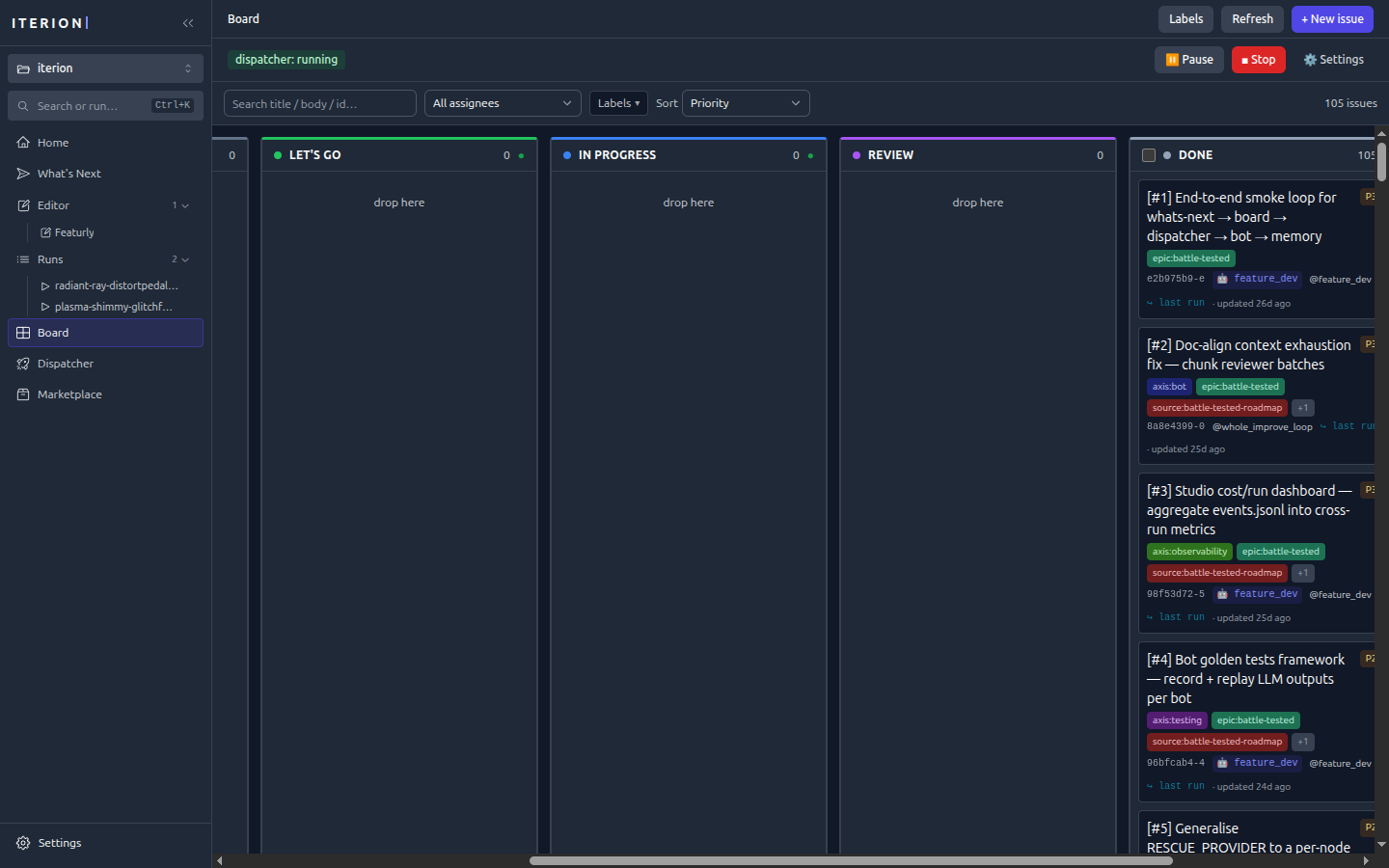
The studio's Board view (/board) is a drag-and-drop front end over this store — cards carry labels, priorities, and per-card bot assignees:
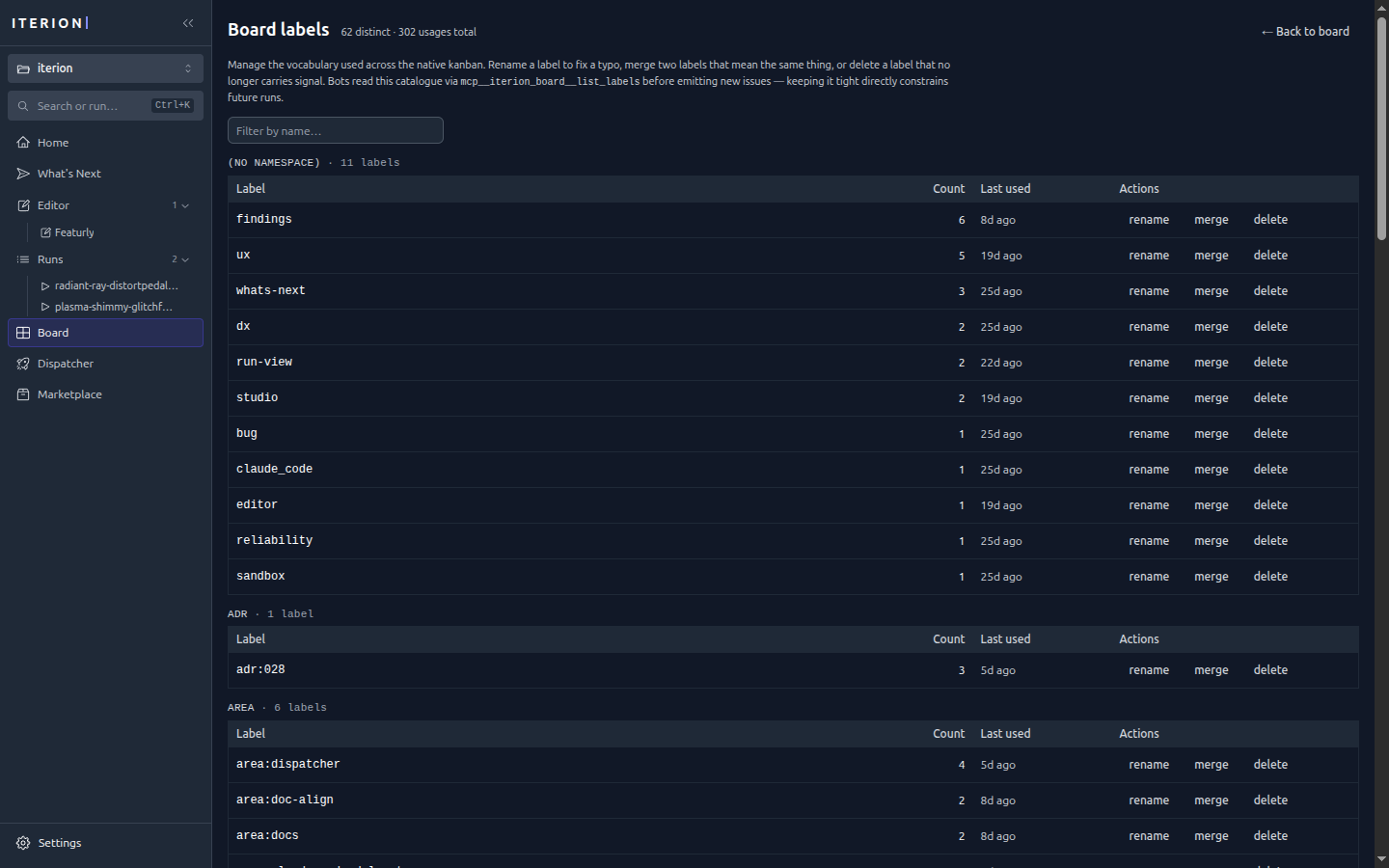
A label manager (/board/labels) keeps the vocabulary tight — bots read this catalogue before emitting new issues, so renaming or merging a label directly constrains future runs:
Storage layout
<store-dir>/dispatcher/
  board.json                  # column + custom-field schema
  issues/<encoded-id>.json    # one file per issue
  events.jsonl                # append-only audit log (monotonic Seq)
<store-dir> is the same directory the runtime store uses (resolved via store.ResolveStoreDir). Issue IDs are native:<uuid> on the wire; the colon is illegal in NTFS filenames, so the on-disk encoding swaps it for __.
Writes are serialized through a single mutex. Each mutation appends one record to events.jsonl. The event types are:
issue_created, issue_updated, issue_state_changed, issue_deleted, issue_claimed, issue_released, issue_last_run_updated, issue_comment_added, issue_blockers_updated, issue_unblocked, issue_gave_up, board_updated, label_rename, label_merge, label_delete.
The dispatcher stamps every issue it processes with last_run_id (the run that handled it) + last_workdir (the worktree path on the host) when the run finishes — success, failure, or cancel. The studio's Board view surfaces these as a "Last run" panel on the issue modal with a link back to /runs/<id> and a vscode://file/<path> shortcut to open the worktree.
Board
board.json defines what columns exist on the kanban and what custom fields the operator can attach to issues. Defaults:
{
  "states": [
    { "name": "inbox",          "display": "Inbox" },
    { "name": "backlog",        "display": "Backlog" },
    { "name": "ready",          "display": "Ready",       "eligible": true },
    { "name": "waiting_deps",   "display": "Waiting on deps" },
    { "name": "in_progress",    "display": "In progress", "eligible": true },
    { "name": "awaiting_input", "display": "Awaiting input" },
    { "name": "review",         "display": "Review" },
    { "name": "done",           "display": "Done",        "terminal": true },
    { "name": "blocked",        "display": "Blocked",     "terminal": true }
  ],
  "fields": [
    { "name": "bot_args", "display": "Bot args", "type": "text" }
  ]
}
inbox is the leftmost state. Bots with board.create capability post their out-of-scope observations there (labeled findings) so operators can triage on /board without a separate inbox surface — drag inbox → backlog to promote, delete the card to dismiss.
waiting_deps holds a ticket whose hard blockers are not yet done (see ADR-076). Non-eligible and non-terminal: neither the dispatcher nor the /pipelines launch loop will start it. Distinct from blocked, which is terminal “won't do” and must not be used as a temporary hold for open deps (a ticket in blocked does not satisfy anyone else's blockers).
awaiting_input holds a dispatched card whose run paused for input (a human node, or an operator soft-pause): the dispatcher parks the card there — non-eligible, claim retained — and a per-tick sweep moves it on once the run reaches a terminal status (see the "Paused runs" section in docs/dispatcher.md). Boards persisted by an older iterion are schema-upgraded automatically on store open (filesystem) or on read (Mongo): missing inbox is prepended, missing waiting_deps is inserted after ready (else after backlog), missing awaiting_input is inserted right after in_progress. Fully-custom boards without those anchors are left untouched for the optional inserts.
| Property | Meaning |
|---|---|
eligible: true | Dispatcher will dispatch issues sitting in this state (subject to hard-blocker gate). |
terminal: true | Dispatcher treats this state as a stop signal for lifecycle. Hard blocker satisfaction is only done (not every terminal state). |
A state can be both eligible and terminal — for example a completed column that triggers a final wrap-up workflow before issues leave the board.
Custom fields
A board may carry typed custom fields. Schema is enforced on every issue write — unknown fields and bad types are rejected.
{
  "states": [...],
  "fields": [
    { "name": "severity",  "type": "enum",   "enum_values": ["low", "medium", "high"], "required": true },
    { "name": "due_date",  "type": "date" },
    { "name": "story_pts", "type": "number" },
    { "name": "external",  "type": "bool" }
  ]
}
type | Value shape |
|---|---|
text | string |
number | int or float |
bool | true / false |
date | RFC3339 string |
enum | string ∈ enum_values |
Field values are rendered into workflow inputs via {{issue.fields.<name>}} in the dispatcher's dispatch.vars block.
CLI — iterion issue
The full CLI works against <store-dir>/dispatcher/ directly; it does not need the dispatcher daemon to be running.
iterion issue create   --title T [--body B] [--state S] [--label L]+
                       [--priority N] [--assignee A] [--blocker ID]+
                       [--field key=value]+ [--bot NAME] [--bot-arg key=value]+

iterion issue list     [--state S]+ [--label L]+ [--assignee A]
                       [--claimed] [--unclaimed]

iterion issue show     <id-or-prefix>
iterion issue move     <id-or-prefix>  --to <state>
iterion issue update   <id-or-prefix>  [--title T] [--body B] [--labels L1,L2]
                                       [--priority N] [--assignee A] [--blockers B1,B2]
                                       [--field k=v]+ [--clear-field K]+
                                       [--clear-last-run]
iterion issue close    <id-or-prefix>          # → first terminal state

iterion issue board show
iterion issue board init [--from <board.json>] [--force]
<id-or-prefix> accepts the full native:<uuid> form, the bare UUID, or any uniquely-matching prefix (e.g. the first 8 characters shown in list).
--field key=value infers the type from the value: true/false → bool, integers / floats → number, everything else → string. Use --clear-field key to unset a value.
--clear-last-run drops the card's last_run pointer. While that pointer names a resumable run the dispatcher resumes it on the next dispatch instead of starting one; clearing it is how an operator gets back to a fresh run after a failure resuming cannot fix. The run history (runs) is kept.
It clears the pointer, not the ticket: a card the dispatcher gave up on is still in a terminal state, so the fresh run materialises once the ticket is restaged too (Retry on the board, or iterion issue move … --to ready). Clear first, then restage — the other order re-pins the pointer.
Two limits are deliberate. It refuses while the run is still alive (running / queued / paused_*): that pointer is also the dispatcher's sibling guard, and clearing it there would let the next dispatch start a second run on the same ticket. And a live dispatcher with a retry already scheduled for the ticket holds its own in-memory pointer, which wins over the persisted one for that attempt — for a ticket the dispatcher has given up on, the retry was dropped at give-up, so the flag takes effect immediately.
iterion issue list accepts --json (the global flag) to emit machine-readable output:
iterion issue list --state ready --json | jq '.[].id'Per-ticket bot / bot_args
The native.Issue record carries dedicated typed routing fields: Bot (string) and BotArgs (map[string]string). At create time the CLI exposes them directly:
iterion issue create --title "Ship X" --state ready \
--bot feature-dev --bot-arg feature_prompt="Ship X exactly as specced"(--field key=value is different: it lands in the freeform Fields map, NOT in BotArgs.) iterion issue update does not expose the two flags yet — to change routing on an EXISTING card use one of:
- the REST API (
PATCH /api/v1/native/issues/{id}with{ "bot": "feature_dev", "bot_args": { "feature_prompt": "…" } }), - the capability-gated board tools (
create_issueandset_botboth acceptbot/bot_args), exposed over MCP to Claude Code and pi RPC and in-process to claw, - the studio issue modal,
- or rely on the dispatcher-side
assignee_workflows:/assignee_dispatch:mappings keyed on--assignee(see docs/dispatcher.md).
REST surface
When iterion runs an HTTP server (iterion studio or iterion dispatch's embedded HTTP), the native tracker is exposed under /api/v1/native/. Auth follows the surrounding server: the studio's local mode is unauthenticated; cloud mode gates the routes through the same JWT middleware as /api/runs/*.
| Endpoint | Method | Body |
|---|---|---|
/api/v1/native/issues | GET | (query: state, label, assignee) |
/api/v1/native/issues | POST | {title, body?, state?, labels?, priority?, assignee?, blockers?, fields?, bot?, bot_args?} |
/api/v1/native/issues/{id} | GET | — |
/api/v1/native/issues/{id} | PATCH | partial {title?, body?, labels?, priority?, assignee?, blockers?, fields?, bot?, bot_args?} |
/api/v1/native/issues/{id} | DELETE | — |
/api/v1/native/issues/{id}/transition | POST | {to: <state>} |
/api/v1/native/issues/{id}/comments | POST | {author?, body} — appends a comment |
/api/v1/native/board | GET | — |
/api/v1/native/board | PUT | full Board |
{id} accepts the same prefix resolution as the CLI.
bot (string) and bot_args (map[string,string]) are dedicated typed columns on the native Issue record; they are not part of the freeform fields map. bot_args is merged on top of the dispatcher's rendered dispatch.vars key-by-key at launch time, with bot_args winning on shared keys. bot is the dispatch routing key: the poll loop sets routeAssignee = iss.Bot whenever it is non-empty, so a per-ticket bot wins over the ticket's assignee for workflow selection, and the bot file is resolved and route-checked before dispatch. assignee_workflows: in the dispatcher config is the routing table consulted under whichever key won. See docs/dispatcher.md §Per-ticket bot + args fields.
The SPA's Board view (/board in the studio) is a thin React shell on top of the REST surface. The table below covers the issue/board CRUD; the label manager and the board-schema editor add GET /labels, POST /labels/rename, POST /labels/merge, DELETE /labels/{label}, and the /board/states*, /board/fields* and /board/views* routes.
Pipeline board (the second board)
The Studio also exposes a single global /pipelines board. This is a different product surface — a control center for watching and unblocking many pipelines at once — not a saved filter and not a replacement for /board:
/boardremains the editable, shared dispatcher backlog;/pipelinesis one global projection of every root pipeline, across all bots;- it has four fixed lanes —
Opened,In progress,Needs attention,Closed(IDsopened,in_progress,needs_attention,closed; the IDs are the wire contract).Needs attentionrenders as its own card board to the RIGHT ofIn progress, and is hidden entirely when empty; - each card is one root pipeline; its descendant runs are folded into the root card (aggregate node progress + a list of pending human reviews), not shown as separate cards;
- a tree blocked on
paused_waiting_humanshows a Blocked — human review tag on the card; the structured answer form lives in the card's details sidebar (click the card) and resumes the exact paused run — when several reviews are pending across the tree the sidebar steps through them one at a time.
Lane semantics — the board is task-centric:
Opened= every not-yet-running ticket (pairs withClosed). A per-card Ready badge marks the ones cleared to leave Opened for In progress (a staged task, or a run already queued for a slot); tickets with open hard deps show Blocked by N / Waiting on deps; the rest show Not ready. The card's Mark ready / Unmark ready buttons flip that state; Mark ready with open blockers parks the ticket inwaiting_deps(or 409 on boards without that state). A not-ready ticket also offers Delete (confirmed, and refused server-side while any run in the tree is active). The launch loop starts ready tickets highest priority firstand only when every hard blocker isdone— samenative.CanLaunchrule as the dispatcher. A header control filters the lane by All / Ready / Not ready;In progress= running or awaiting a human review (progress bar + Blocked tag). A running card offers Pause (soft operator pause — the engine checkpoints at the next safe boundary; Resume appears while paused); a ticket-backed card offers Reset (cancels the run tree, then restages the ticket to Ready for a fresh start); a ticket-less card offers Stop (plain cancel → the run lands in Closed as failed);Needs attention= pipelines that died mid-flight (failed/failed_resumable) and want a human. Deliberately NOT Closed: closed means "this reached its end", and a crash did not. A card here shows the error, and — crucially — holds one concurrency slot open so the operator's fix restarts into it instead of queueing behind whatever grabbed it. Nothing runs against a held slot: no goroutine, no LLM budget. The card offers Retry (primary — restages to Ready), Resume from checkpoint (menu, only forfailed_resumable), Reset, and Close. A run the operator cancelled is a decision rather than an anomaly and goes to Closed without reserving — otherwise Stop would punish the operator who pressed it, and Close would retain the very slot it exists to release. Failures iterion caused itself (a drain at shutdown, the boot orphan sweep) show here but do not reserve, or every restart would hold every slot. A dispatcher give-up also lands here even though its ticket reads terminal — see below;Closed= every pipeline that reached an end: finished, or stopped by the operator. A per-card Success / Stopped badge distinguishes the outcome; a successful card's output shows in the details sidebar, a stopped one shows the reason and (ticket-backed) offers Retry (restages to Ready) + Edit. A header control filters the lane by All / Success / Stopped.
A dispatcher give-up is not a filing. When iterion dispatch exhausts agent.max_attempts on a ticket it files it into agent.failed_state (default blocked) by itself — the same terminal state the board's Close writes. A terminal ticket otherwise means "a human already filed this", so before the give-up stamp the projection could not tell the two apart and put the card in Closed: the one class of failure the Needs-attention lane exists for — a pipeline that died and wants a human — was the one it never showed, because a deterministic failure (a fail-closed bot demanding a rewind) burns the whole retry budget on every run.
The dispatcher therefore stamps the give-up on the ticket (Issue.gave_up: the run, the state it wrote, the attempt count, an issue_gave_up event), and the projection routes a terminal ticket carrying a current stamp to needs_attention, badged Gave up.
The stamp expires by itself, and permanently: it names the run and the state, the store drops it on any write in a different state (one hook on each store's write path, so no future state writer has to remember), and a stamp naming another run never describes the card. That permanence is load-bearing — a dispatcher retry resumes the same run id, so a stamp that merely looked stale would come back to life the moment a human filed the ticket back into that state, and the board would re-file an operator's own decision as an unattended give-up.
The one case no write hook can catch is filing a ticket into the state it is already in — the give-up's target and every close target are the same state. So the three closes clear the stamp explicitly: the pipeline board's Close, iterion issue close, and the board tool close_issue. That is what makes closing the acknowledgement the give-up never got.
A given-up card renders in the lane but reserves no slot: it is terminal, nothing will relaunch it until the operator acts, and holding capacity for it would leak a slot with no bound.
Getting back to a fresh run. A ticket's last_run_id pointer is what the dispatcher resumes on the next dispatch (resolveRunID → resumableRunID), so a run that died in a way resuming cannot fix keeps being resumed — and plain Retry does not change that: it only restages the ticket, and whoever claims it decides what "retry" meant (the studio's admission loop mints a fresh run; a live iterion dispatch resumes the dead one).
Two surfaces drop the pointer, and both keep the run history (Issue.runs) — those runs happened, and their consoles are the evidence:
- ⋯ → Retry from zero on the card (
POST /api/v1/pipeline-board/tasks/{id}/resetwith{"fresh": true}) — the board answer, offered wherever Retry is once the run has settled. It cancels the tree, drops the pointer, then restages, so both launch authorities can only mint a new run. iterion issue update <id> --clear-last-run— the CLI equivalent, for a ticket you are already driving from a terminal.
Both refuse while a run is still going, and for the same reason: the pointer is also the sibling guard, so dropping it beside a live run lets a second one start on the same ticket. fresh refuses before its cancel sweep — nothing is cancelled, nothing is restaged, and the 409 names the run — which keeps it out of the window Reset's pin exists to close (Reset pins a still-dying run as the current attempt precisely so the relaunch waits for it). fresh reads the whole run tree; --clear-last-run reads the pointer run only.
Closing a pipeline. Close (⋯ menu, every non-terminal lane) cancels everything still alive under the card and files the ticket as abandoned (blocked), never done. That is a correctness choice, not wording: native.BlockerSatisfied counts only done, so closing a broken pipeline as done would release every ticket parked behind it into work whose input was never produced. The confirm dialog names the dependents that will stay waiting. Close is also the release valve for a held slot — without it a failure the operator does not intend to fix would hold capacity forever. Close is ticket-scoped only: a run-only card has no state to file, reserves nothing, and is already projected into Closed — use Stop for those.
Slot reservation. The reserved count is derived from (ticket state × run status) on demand — no persisted field, nothing to rebuild after a restart — and is enforced inside the run service's concurrency queue rather than in the studio's admission loop. That placement matters: slotFreed runs in the dying run's own goroutine and immediately wakes the FIFO drain, so a gate sitting only upstream would hand the freed slot to a waiter microseconds before any 2s admission tick could notice the reservation, and it would miss the five other launch paths (Launch modal, triggers, two webhook paths, board dispatch) that know nothing about a board. A relaunch of the holding ticket consumes its own reservation instead of being refused by it. The studio's concurrency chip reads N running · M needs attention · max K, and the queue banner says so explicitly when held slots are what stopped admission.
Hard dependencies (blockers). Ticket-to-ticket DAG (roots only — not sub-bot runs). Satisfied only when the blocker issue is in state done (not merely terminal). Optional extra gate: set bot_args.require_blocker_labels (e.g. accepted) so a done blocker still blocks until it carries those labels (artefact acceptance without a second state machine). Projection fields on each card: blockers (enriched {id,title,state,bot,satisfied,missing_labels?}), open_blocker_count, launch_blocked_reason, blocking (reverse index, computed on read). When the last blocker reaches done (and labels if required), dependents in waiting_deps auto-promote to backlog (or ready if bot_args.auto_ready is truthy) and emit issue_unblocked. Full contract: ADR-076.
Ticket contract (bot_args)
Iterion stays game-agnostic. Cross-bot multi-pipeline tickets share a small well-known key vocabulary (constants in pkg/dispatcher/native/ticket_contract.go). Bots own the immutable request JSON on disk; the board only routes execution.
| Key | Role |
|---|---|
input_path | Path to the immutable request file (primary). Upsert key with bot. |
revision_id / request_hash | Immutability / cache identity |
asset_id / feature_id / family_id | Correlation / bulk filters |
pipeline_kind | mesh | humanoid | feature | custom — UI filter |
produces / consumes | Serialized artefact / dependency lists (JSON strings) |
doc_refs | Optional design refs |
auto_ready | Truthy → auto Ready when unblocked (else backlog) |
require_blocker_labels | Comma-separated labels required on every hard blocker |
spawned_from | Planner ticket id that published this card (synced with Issue.ParentID) |
role | Optional planner | producer hint for UI grouping |
Planner provenance. Distinct from hard blockers (scheduling): a planner ticket can spawn child tickets via board.create / POST …/tasks. When the creating run is sourced from a ticket, parent_id / spawned_from is auto-stamped. The /pipelines projection exposes parent_issue_id, children[], and children_summary so Inventory can group children under a collapsible plan card.
The /pipelines drawer surfaces these under Ticket contract before the generic inputs list.
Upsert. Planners re-run without flooding the board: POST …/tasks with upsert: true and bot_args.input_path updates the existing card matching (bot, input_path) (title / blockers / bot_args). Does not reset state when the ticket is already in_progress / done / awaiting_input.
Multi-engine access. Board mutations do not require Claude-specific MCP tools. The canonical fallbacks work across Claude Code, claw, pi, Kimi, Grok, Codex, and scripts:
- REST —
/api/v1/pipeline-board/*and/api/v1/native/issues/*(this page); - CLI —
iterion issue create|list|show|update|move … --blocker … --bot … --bot-arg key=value; - HTTP MCP —
/api/v1/mcp/board(ephemeral run token) for sandboxed agents.
Ticket movement is button-driven — there is no drag & drop. The studio's launch loop starts ready tickets when a concurrency slot frees (no iterion dispatch needed). Run cards (In progress / Closed without a ticket) are positioned by run state and cannot be moved. Per-lane filters are client-side and compose on top of the global search / bot / label / pipeline_kind / family_id / “Waiting on deps” bar.
The aggregate read API is intentionally server-side, so the browser does not perform an N+1 traversal over issues, checkpoints and child runs:
| Endpoint | Method | Purpose |
|---|---|---|
/api/v1/pipeline-board | GET | Global projection: 4 fixed lanes (Opened, In progress, Needs attention, Closed) + one folded card per root pipeline (progress, pending reviews, deps, contract args, output, concurrency). Optional ?since=<duration|RFC3339> prunes CLOSED cards last changed before the cutoff (live pipelines are never pruned) so a long-lived store escapes the ≤500-card truncation banner; the prune is reported via hidden_closed_count / hidden_closed_before |
/api/v1/pipeline-board/tasks | POST | Create a ticket; bot required; optional blockers, upsert; {start:true} → ready when deps OK else waiting_deps |
/api/v1/pipeline-board/tasks/{id}/ready | POST | {ready} stages Ready when hard deps are done, else parks in waiting_deps (or 409); unstage → backlog |
/api/v1/pipeline-board/tasks/{id} | PATCH | Edit a not-yet-run ticket (title, body, labels, priority, bot, bot_args, blockers) |
/api/v1/pipeline-board/tasks/{id} | DELETE | Delete a ticket (issue only, never a run); 409 while any run in its tree is active |
/api/v1/pipeline-board/tasks/{id}/reset | POST | Cancel every active run in the ticket's tree, then restage it to Ready. Optional body {"fresh": true} (⋯ → Retry from zero) also drops last_run_id before restaging, so no launch authority can resume the discarded run; refused with 409 — before the sweep, nothing touched — while any run in the tree is non-terminal |
/api/v1/pipeline-board/tasks/{id}/close | POST | Cancel the ticket's tree and file it terminal (blocked, never done); also clears a dispatcher give-up stamp — Close is the acknowledgement |
/api/v1/pipeline-board/tasks/{id}/dependency-graph | GET | Limited-depth hard-dep graph (also GET /api/v1/native/issues/{id}/dependency-graph) |
/api/v1/pipeline-board/bulk/ready | POST | {ids?|family_id?|pipeline_kind?} stage many tickets Ready (skip open blockers by default) |
/api/v1/pipeline-board/bulk/recompute-deps | POST | Re-promote waiting_deps tickets whose blockers are now satisfied |
Local concurrency cap. iterion studio caps concurrent root pipelines at --max-concurrent-pipelines (default 3; also ITERION_MAX_CONCURRENT_PIPELINES). Ready tickets and direct launches beyond the cap wait until a slot frees; a paused-for-review pipeline frees its slot so reviews never starve the queue. 0 disables the cap. Local (in-process) only; cloud admission stays on the NATS queue + org/team gates. The launch loop stands down while an operator-started dispatcher is running (it would otherwise race the same tickets).
Task ingestion reuses native issues in this slice. A task appears before launch only when its Issue.Bot names a bot; once a run exists, manual/API/scheduled runs associated with that bot also appear even if no native issue references them. See ADR-074 for the boundary, trade-offs and follow-ups.
Use cases beyond the dispatcher
Even without iterion dispatch running, the native tracker is useful as a local kanban for:
- Pre-flight backlog grooming. Curate issues before flipping the switch on the dispatcher.
- Per-project task lists. The store lives under the same
<store-dir>as your runs, so issues travel with the project. - Lightweight personal queue. Replace a sticky-note
TODO.mdwith something that survives reflows, accepts custom fields, and speaks JSON.
Feeding the first column (the canonical ingest contract)
The board's leftmost column is the single, canonical entry point for new work — whatever puts a card there (CI, an API caller, another pipeline, or an operator clicking "add") uses the same contract:
POST /api/v1/native/issueswith nostate.Store.Createdefaults an emptystateto the board's first column (store.go —in.State = States[0].Name), so an ingester never needs to know the column's name. The body may carrybot/bot_argsto pin the pipeline that will run the card (parity across REST, the MCPcreate_issueboardop, and claw'smcp.iterion_board.create_issueexposure). Authenticate a machine caller with aiap_PAT (see Programmatic access).CI / external API (6a). A CI job POSTs a finding straight onto the first column — no dispatcher required.
A pipeline feeding the board (6b). A run-completion
run.finishedtrigger event chains a downstream launch (serviceLauncher/NativeBoardEffect) that can create the next card.Forge import (6a, self-hosted).
syncForgeIssuesToBoard(board_forge.go) is the store-agnostic core that mirrors a repo's forge issues into a native board — one-way, forge is the source of truth, cards land in the first column on create and refresh in place on update (see ADR-071). The self-hosted entry point isiterion issue import, which builds the forge client for you and drives that same core against a local board:sh# github.com (base URL defaults to the github.com API): GH_TOKEN=ghp_… iterion issue import \ --forge github --repo owner/name --token-env GH_TOKEN # a self-hosted forgejo/gitlab (base URL is required): FORGE_TOKEN=… iterion issue import \ --forge forgejo --repo owner/name \ --base-url https://forge.example.com --token-env FORGE_TOKEN \ --since 2026-07-01T00:00:00Z # optional; empty = full re-syncThe token is read only from the named env var (
--token-env), never a flag value. Pull requests are skipped; open issues land in the first column, closed ones in the terminal column. The import is idempotent — re-running upserts existing cards (keyed by a deterministicnative:<uuid>derived fromprovider:repo#number) instead of duplicating them, so it doubles as an incremental--sincesync. The command printscreated/updatedcounts (--jsonfor machine output). The exported Go wrapper isserver.ImportForgeIssues, which keeps the forge-client provider switch in one place.
Programmatic access
The Go package is exported:
import "github.com/SocialGouv/iterion/pkg/dispatcher/native"

s, err := native.NewStore(storeDir + "/dispatcher")
if err != nil { return err }

iss, err := s.Create(native.Issue{Title: "do a thing", State: "ready"})
list, err := s.List(native.ListFilter{States: []string{"ready"}})
_, err = s.SetState(iss.ID, "in_progress")
tok, err := s.Claim(iss.ID, "worker-1") // returns a fenced ClaimToken + lease
err = s.RenewClaim(iss.ID, tok)         // heartbeat the lease while working
err = s.ReleaseOwned(iss.ID, tok)       // fenced release
Claim stamps a lease (claim_lease_until) and a fencing claim_epoch, returning the tracker.ClaimToken every owner-scoped write (SetStateOwned / SetLastRunOwned / SetAwaitingInputOwned / SetGaveUpOwned / ReleaseOwned / RenewClaim) must present — a compare-and-set on (claim, claim_epoch), so a worker whose claim was stolen finds its late writes refused (tracker.ErrClaimConflict). The tokenless Release and SetState remain for callers acting on unclaimed cards. The claim watchdog (ADR-096) reclaims expired leases by transfer; see the dispatcher doc's Claim lease + watchdog section.
Terminal board states are sinks: SetState refuses to leave one (tracker.ErrTerminalStateExit, which wraps ErrTransitionRejected). Reopen(id, toState) is the one sanctioned exit (operator surfaces); SetStateFrom(id, from, to) is the CAS move for automated writers.
To plug it into the dispatcher's Tracker interface:
adapter := native.NewAdapter(s) // satisfies tracker.TrackerLimitations (v1)
- No bi-directional sync with GitHub / Forgejo. A single dispatcher instance picks one tracker. Mirroring is on the v2 roadmap.
- No persistent retry queue. Restart loses in-flight backoff timers; the next tick re-discovers candidates via the tracker.
- Migration on board.json changes is manual. Renaming a state leaves existing issues in the old name, surfaced as "Unmapped" in the SPA. v2 will support an explicit migration step.
- Field validation is closed-world. Add a new
Fieldto the board before writing any issue that references it.